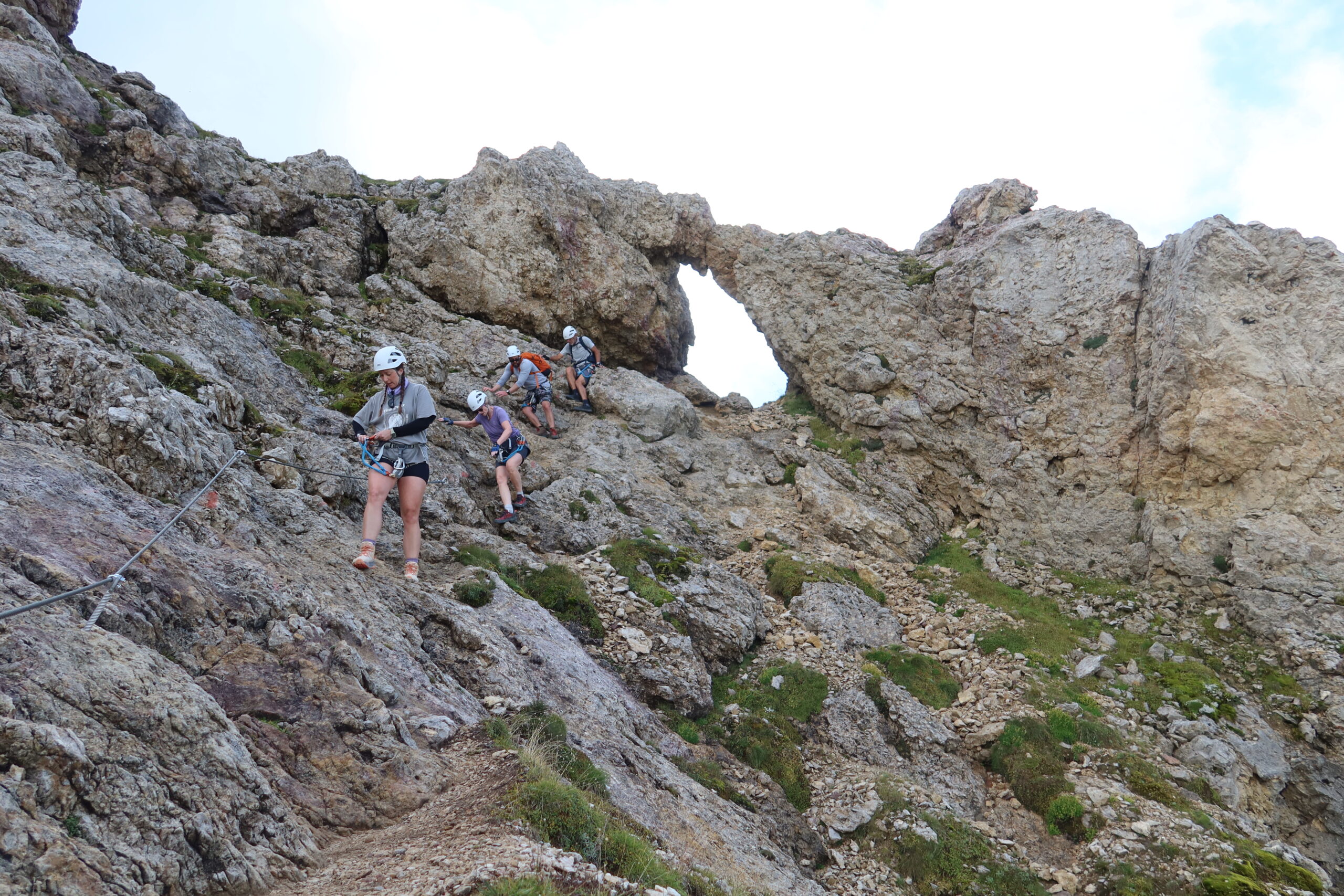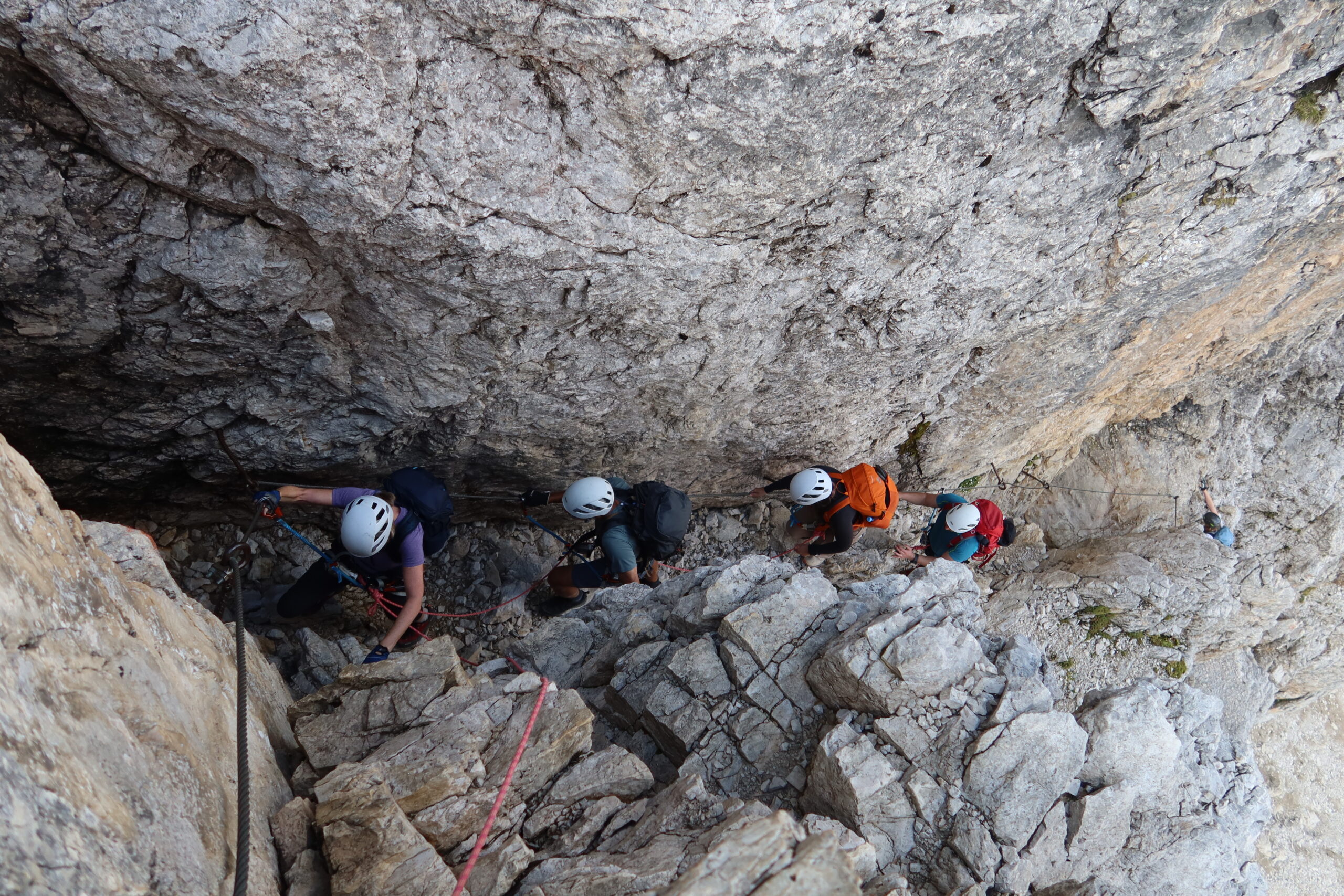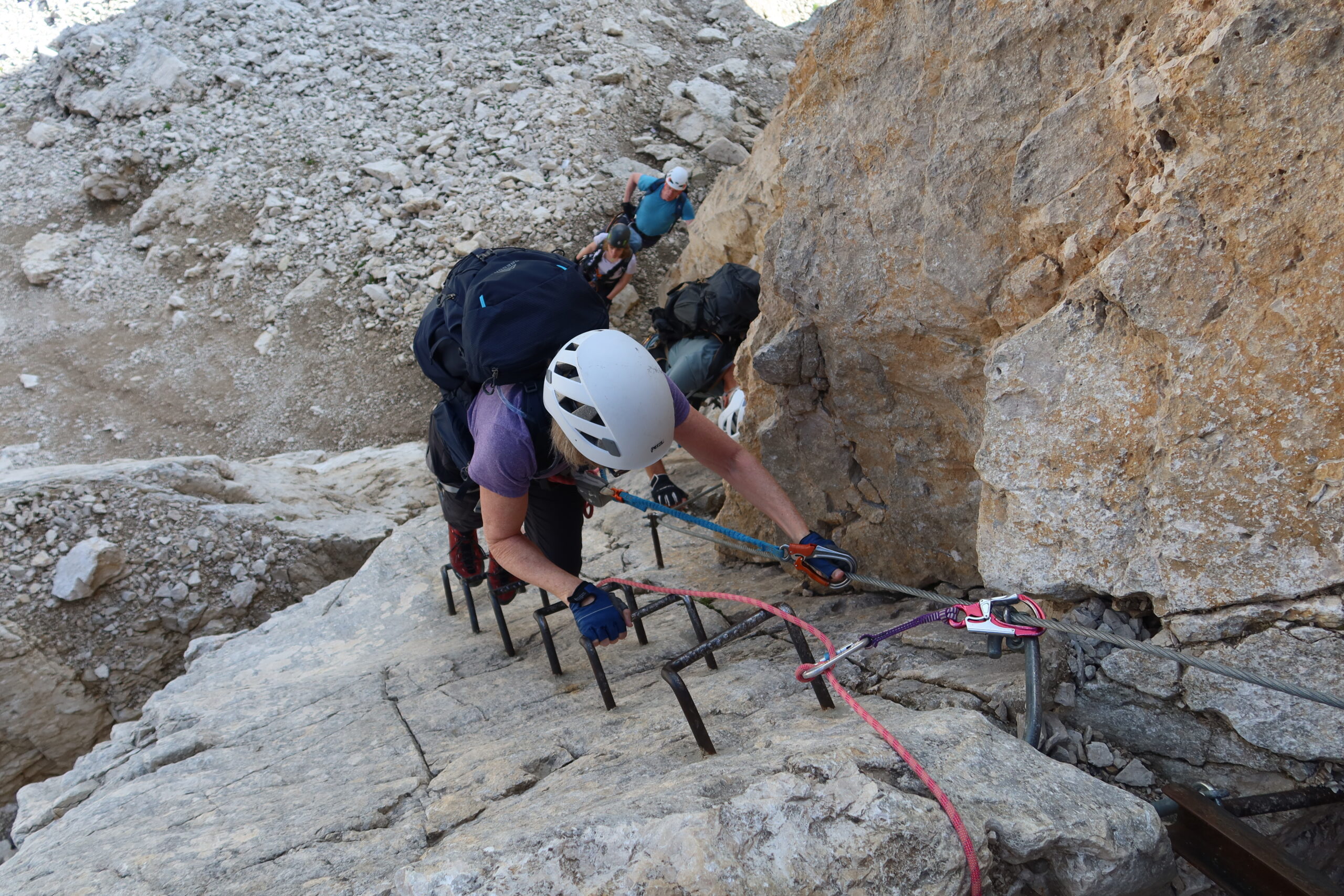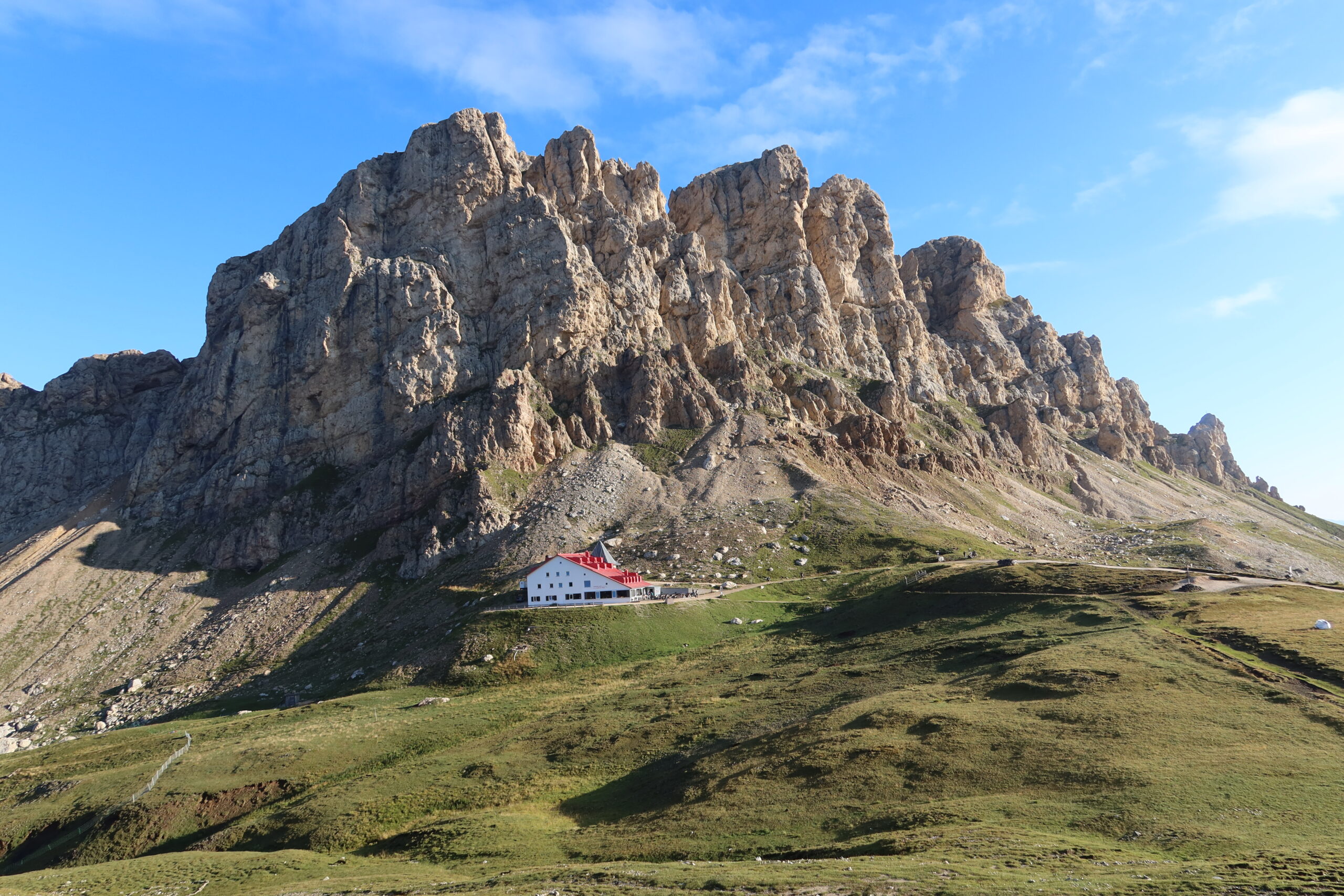
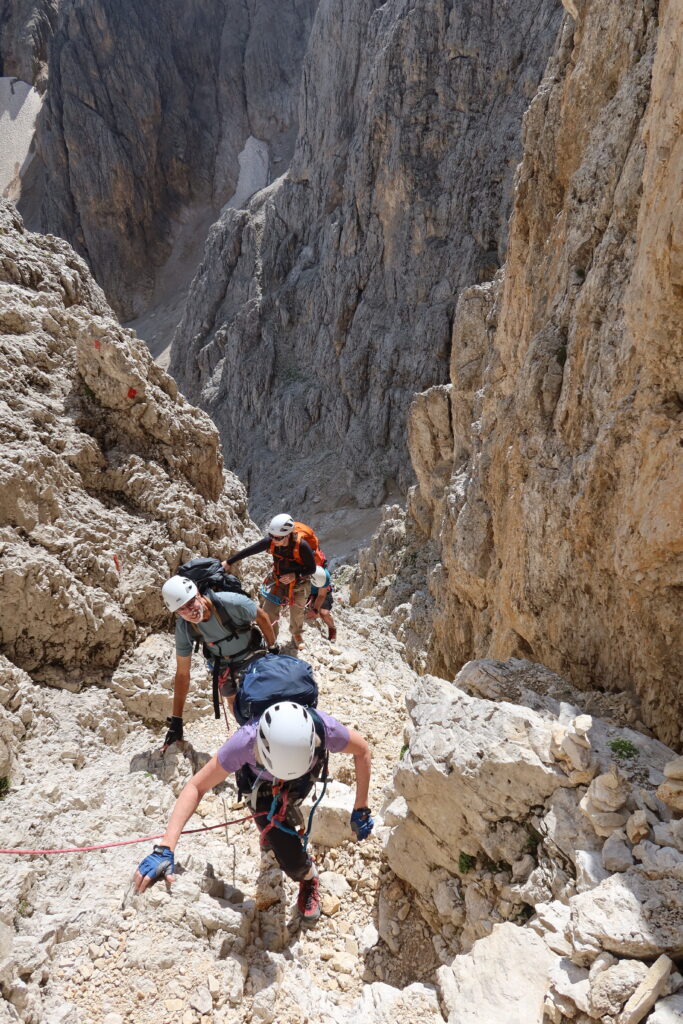
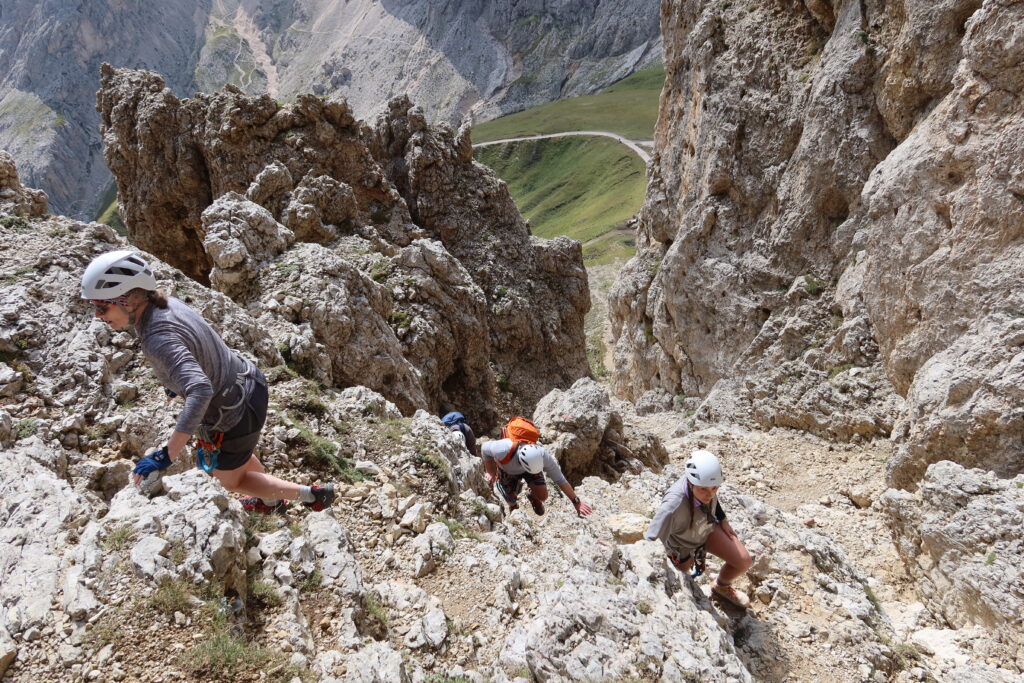
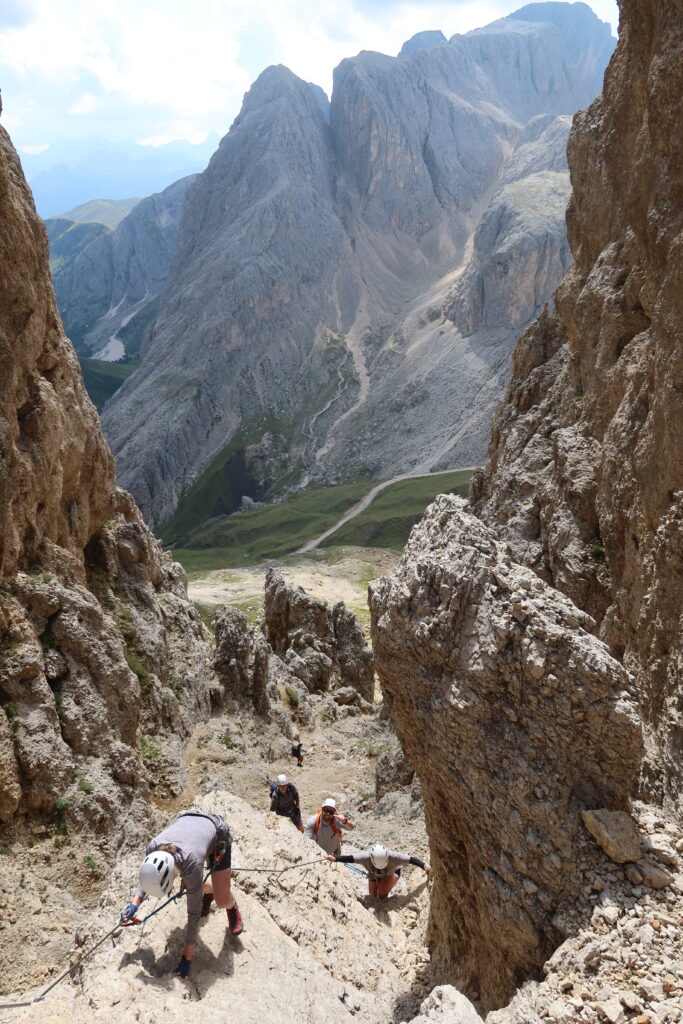
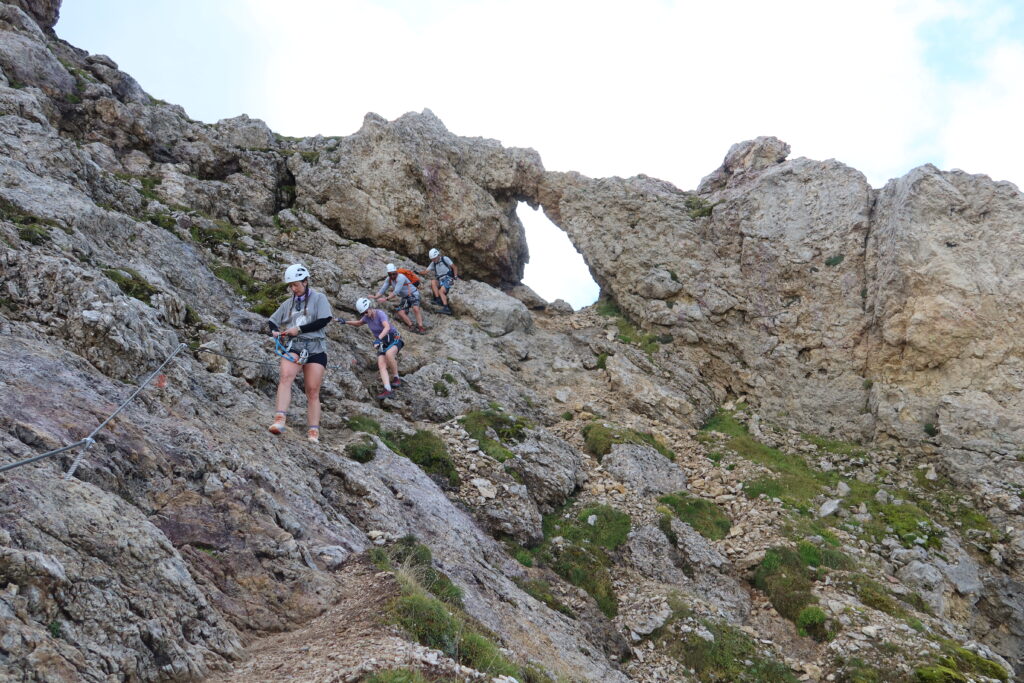

Rosengarten Dolomites Via Ferrata Hut Trek
Alps / Italy / Dolomites
6-day hut-to-hut trekking and via ferrata
In the spectacular “Rose Garden” / Catinaccio, Western Dolomites
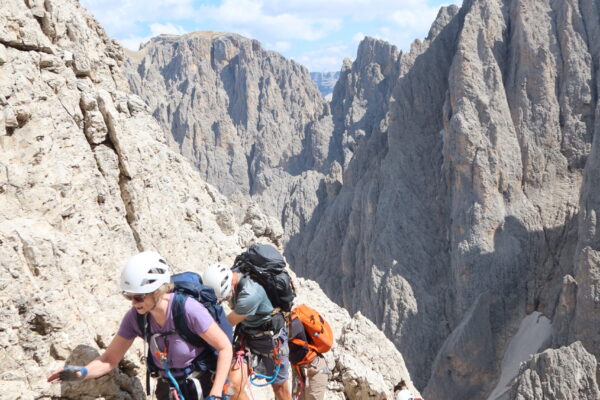
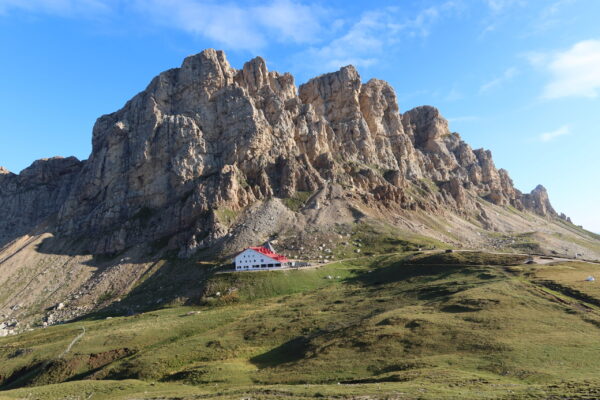
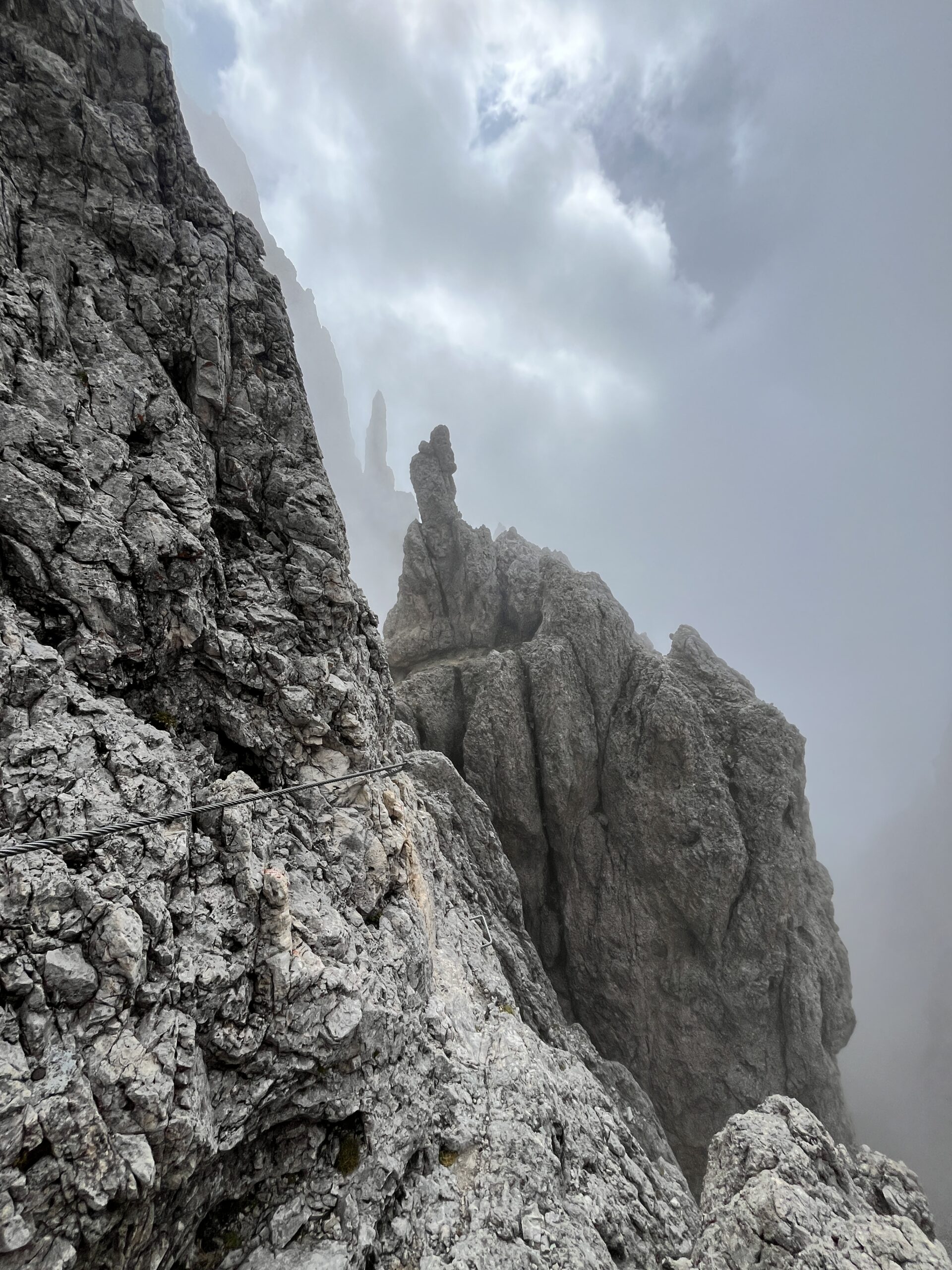
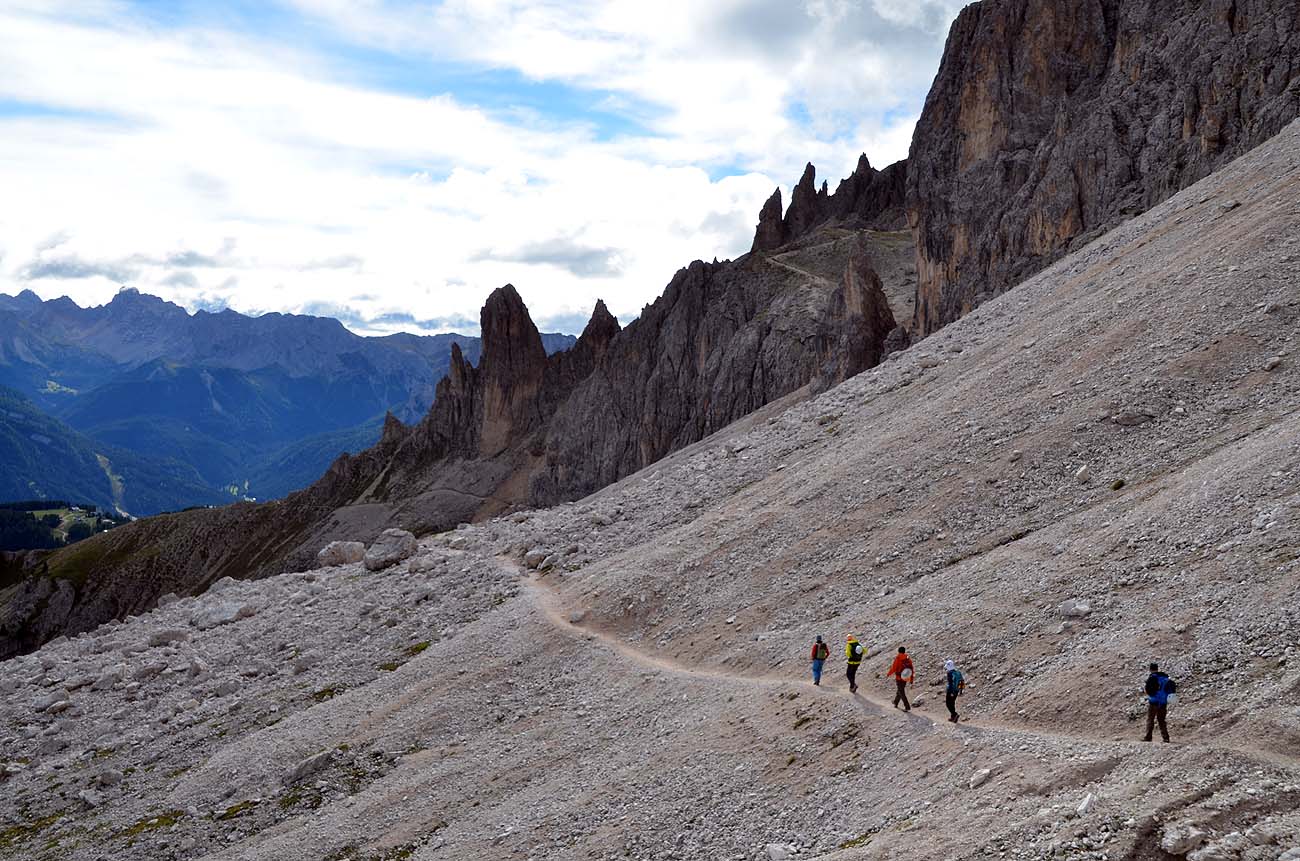
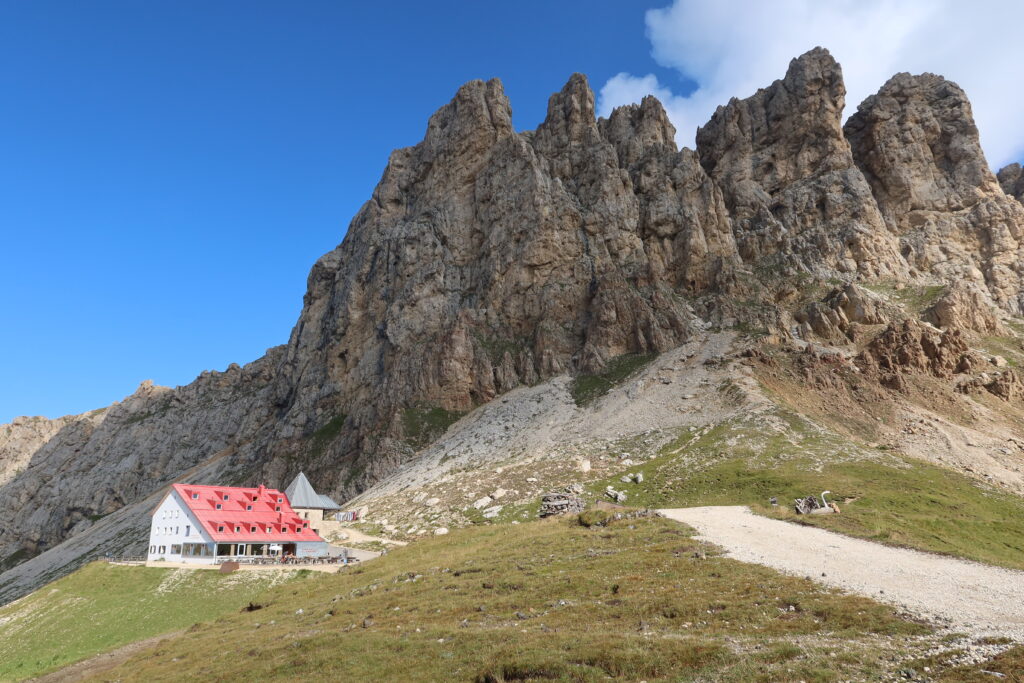
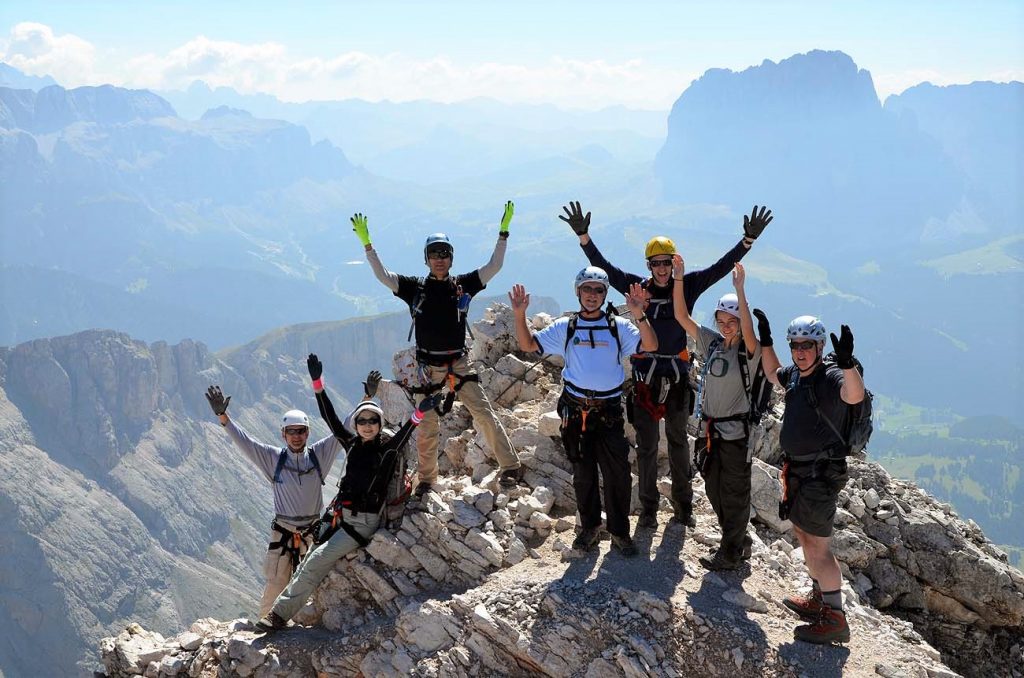
Dolomites – a name that defines unsurpassed mountain scenery. Stunning limestone towers rise steeply above lovely mountain villages and green valleys. Although part of Italy, this region is where Austrian (Tyrolian), Ladinian, and Italian cultures overlap, making for rich history and culture.
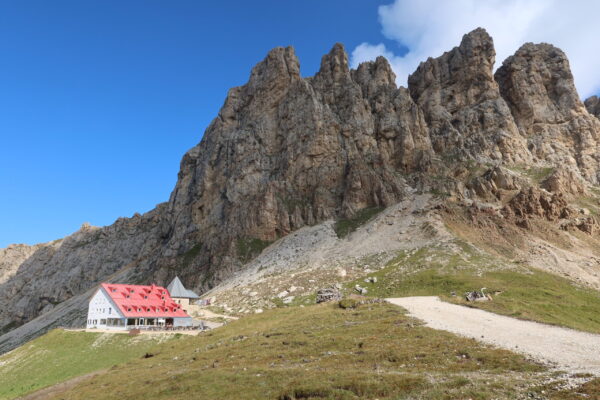
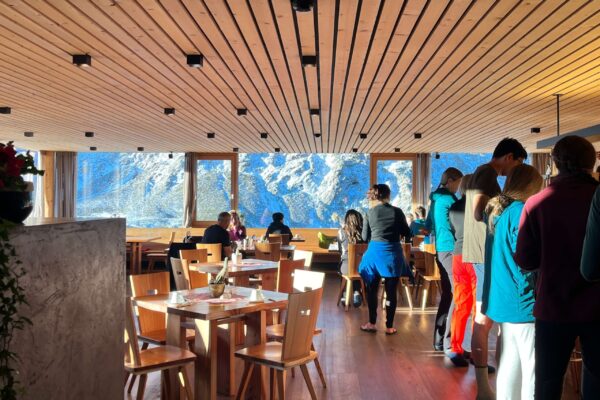
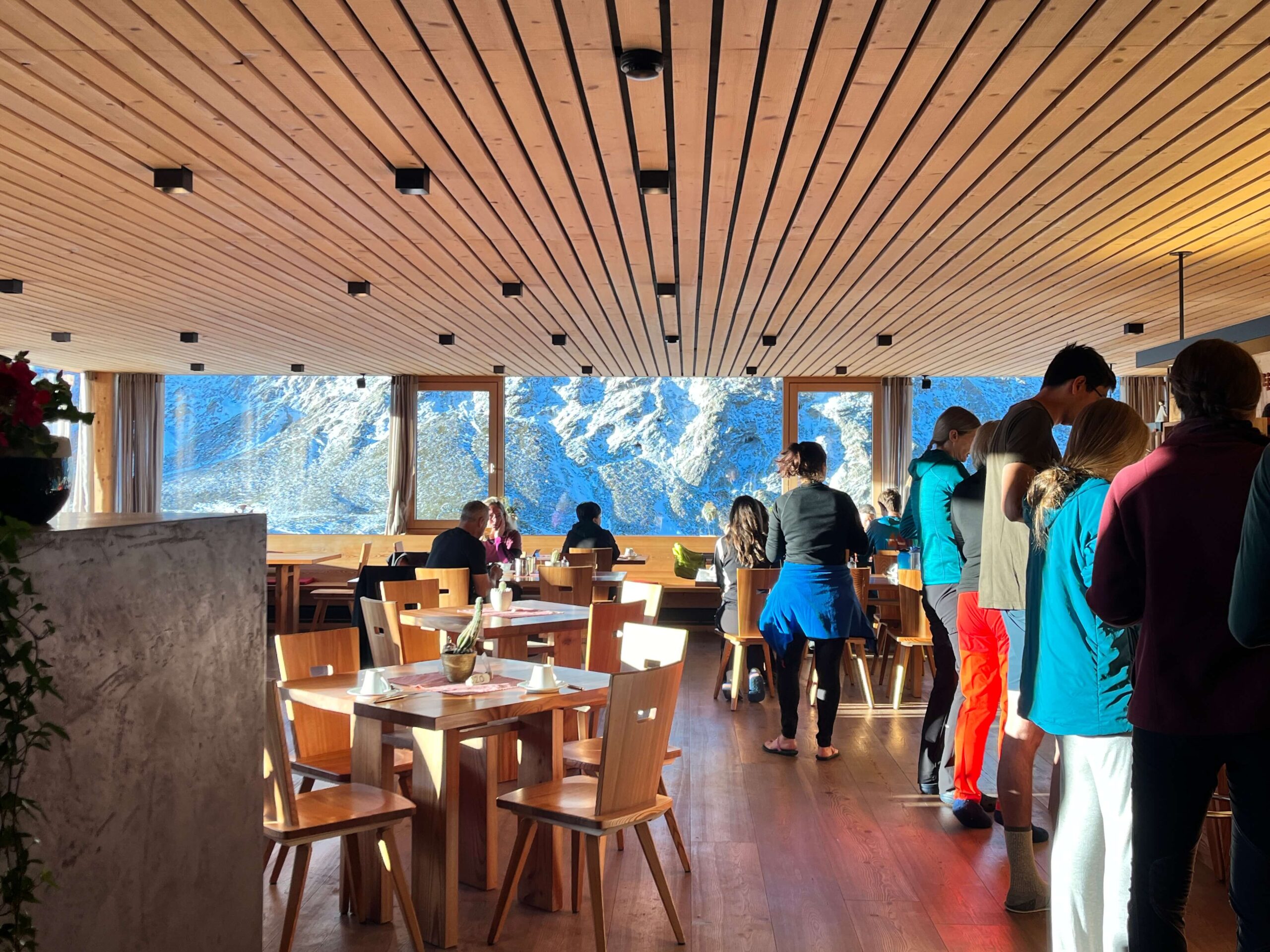
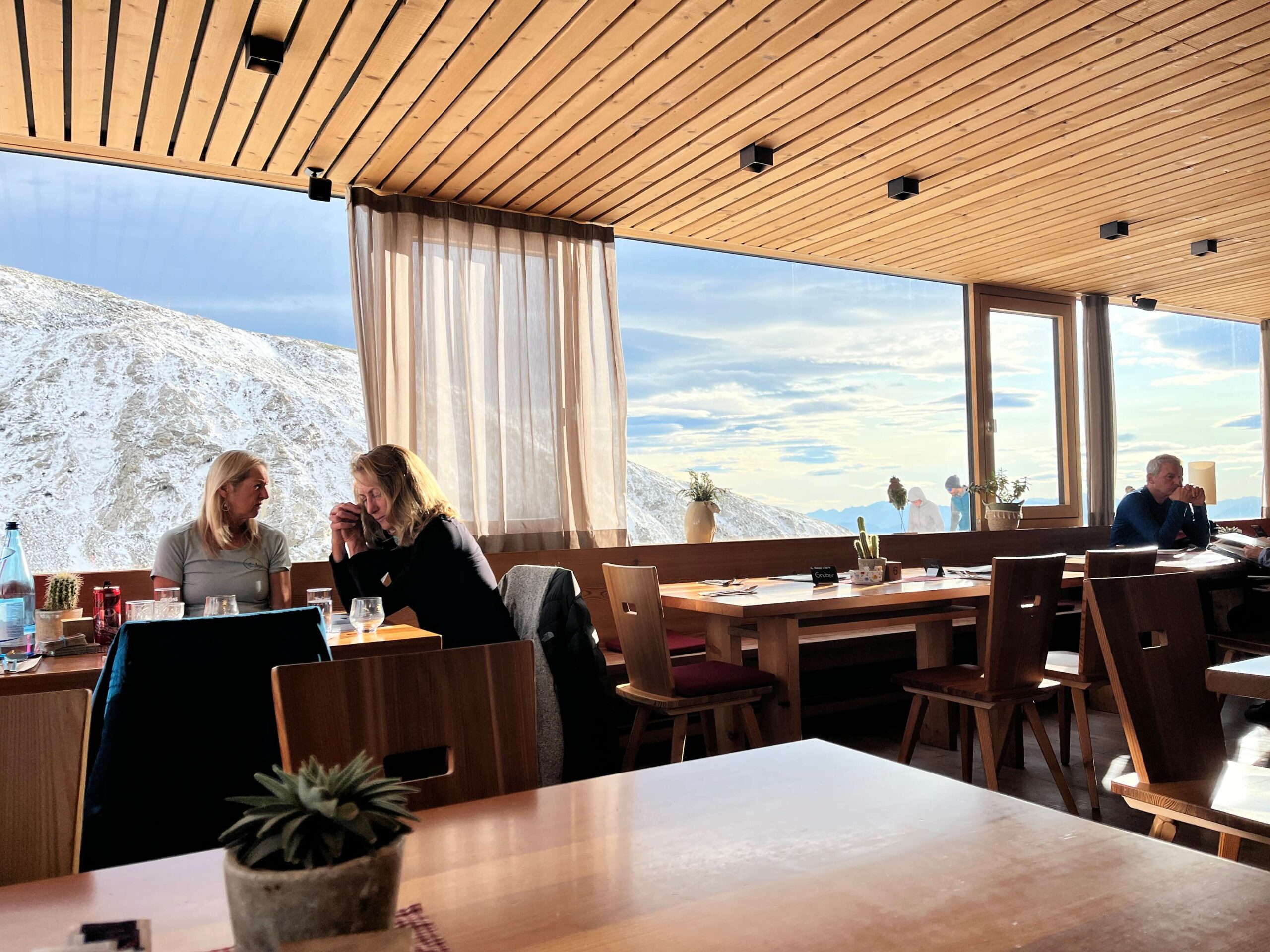
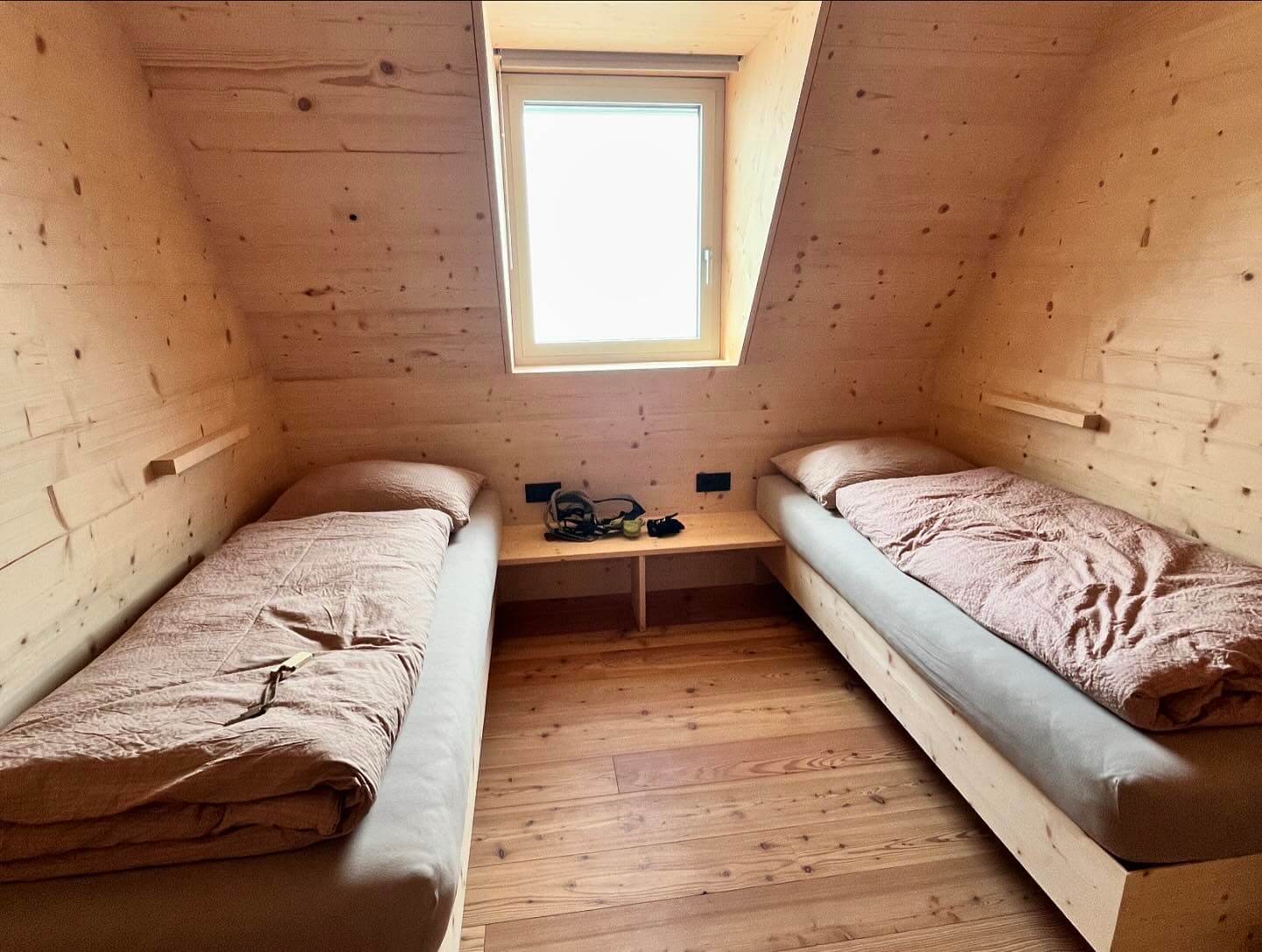
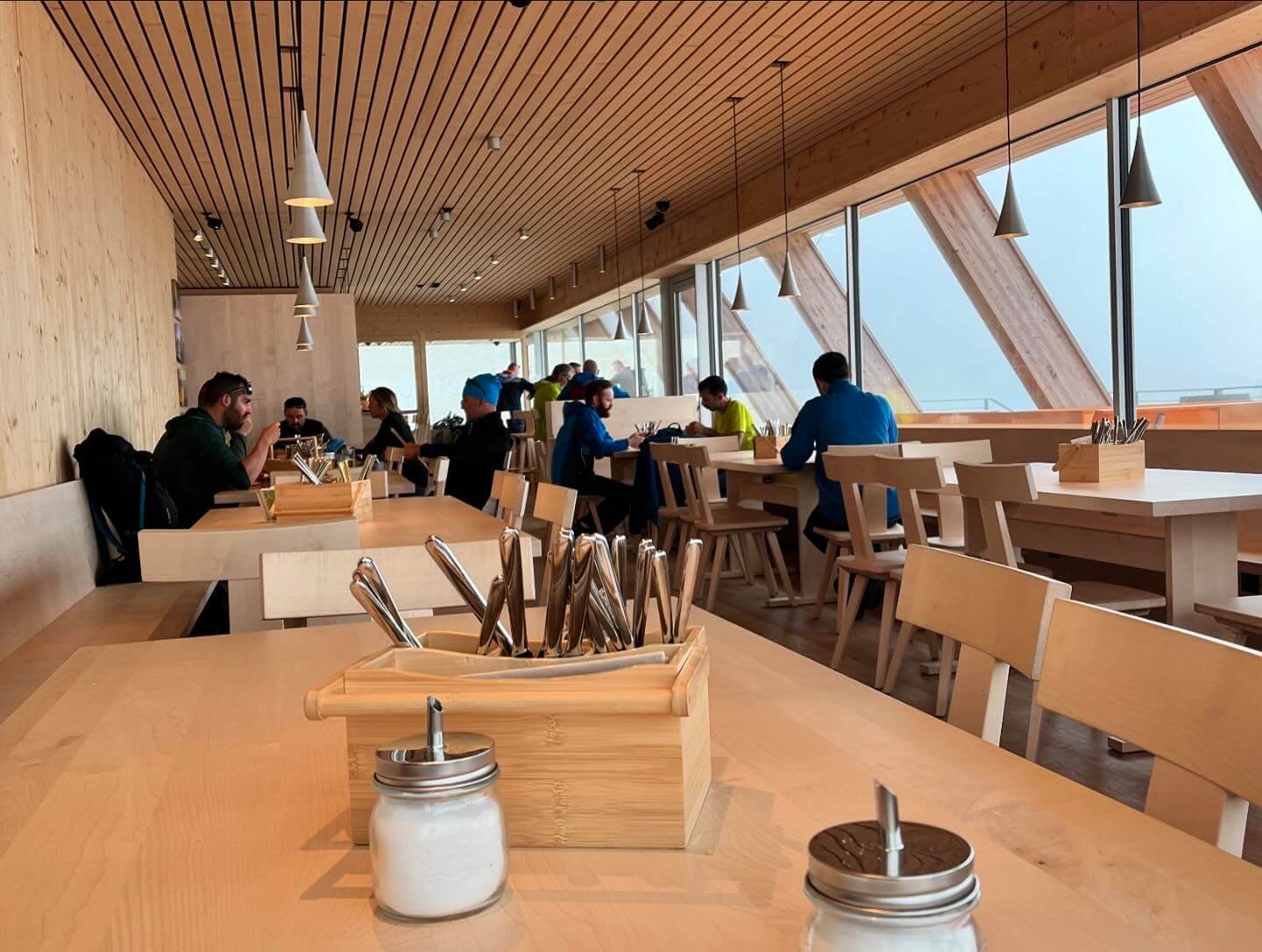
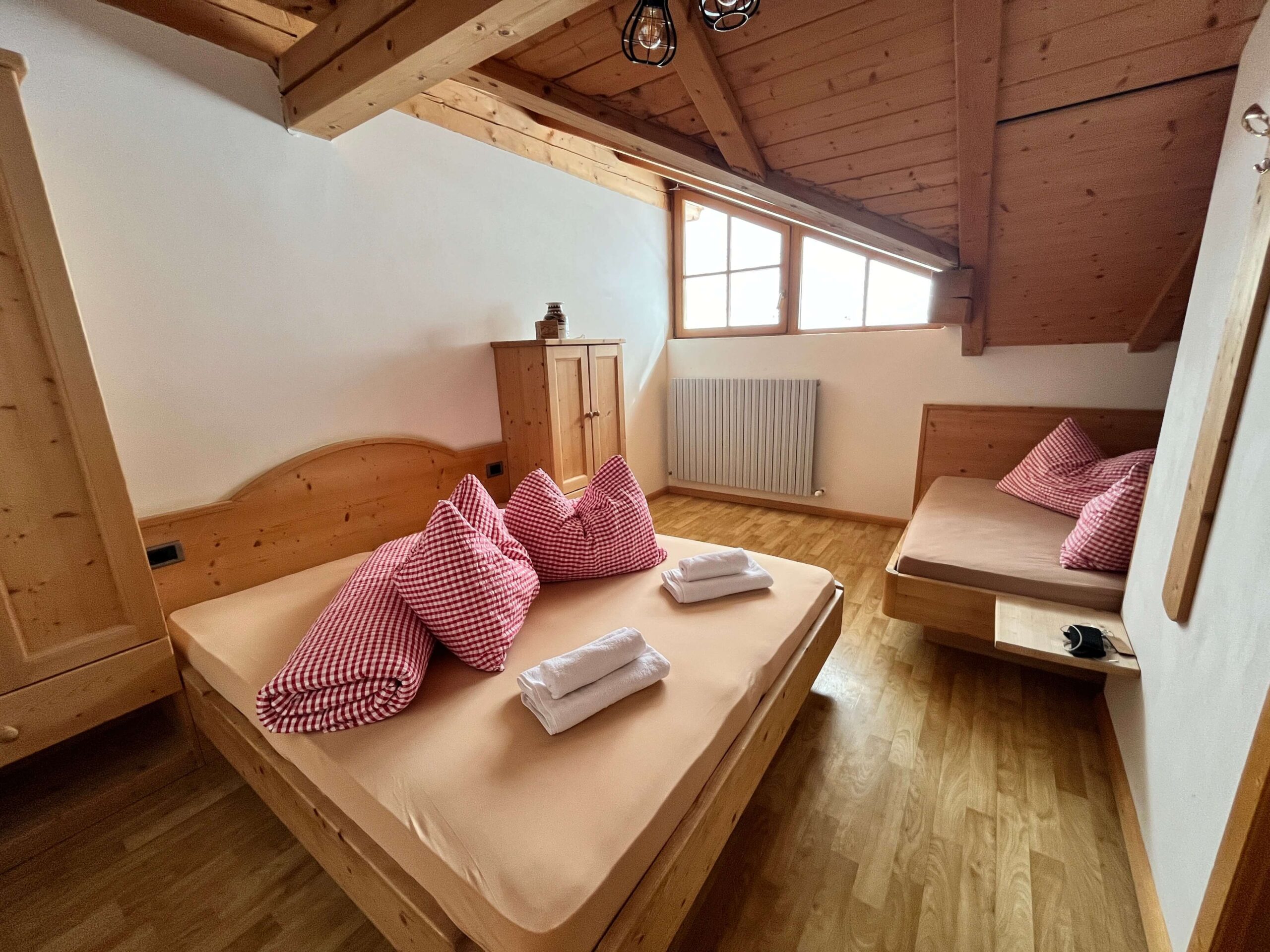
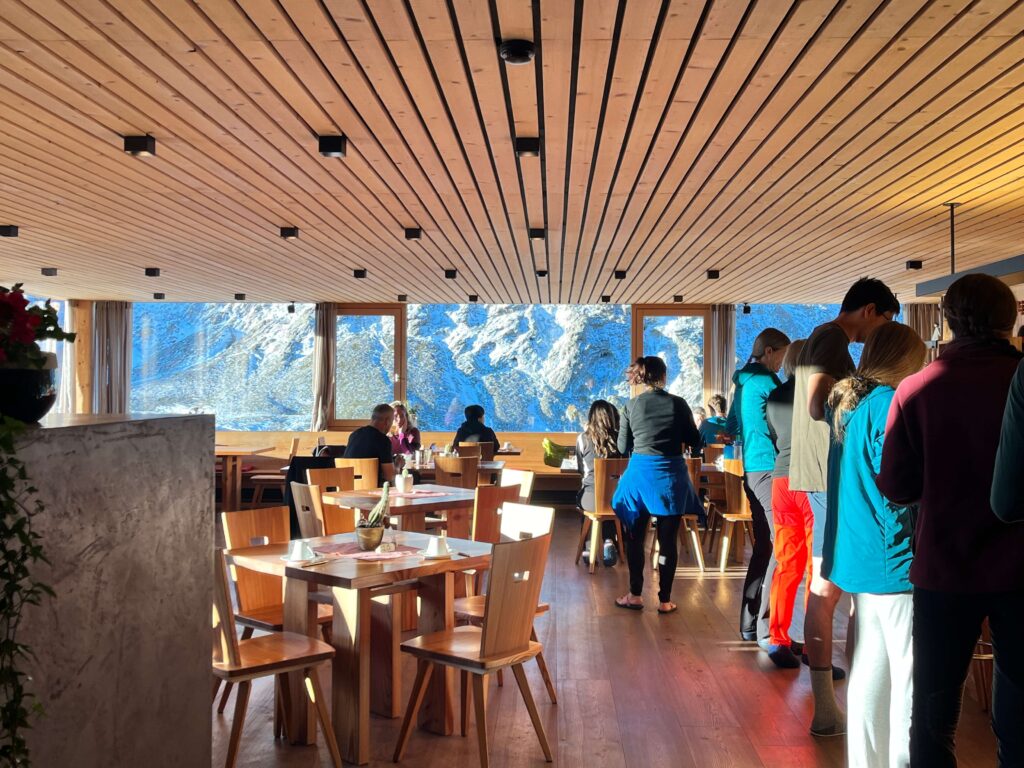
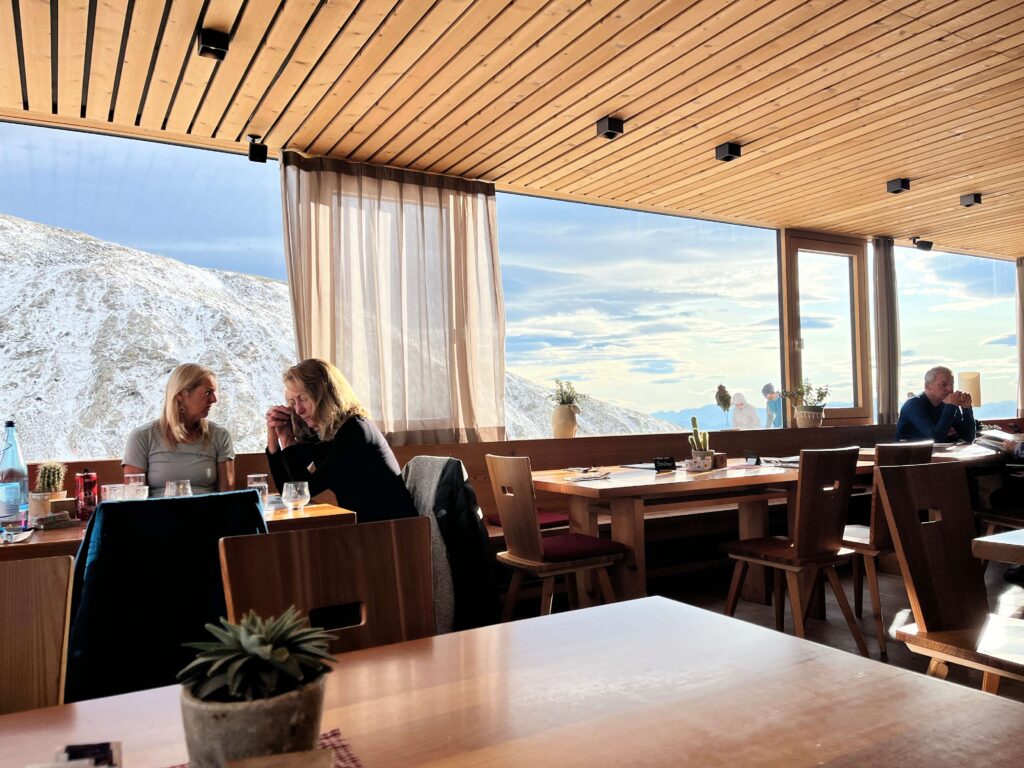
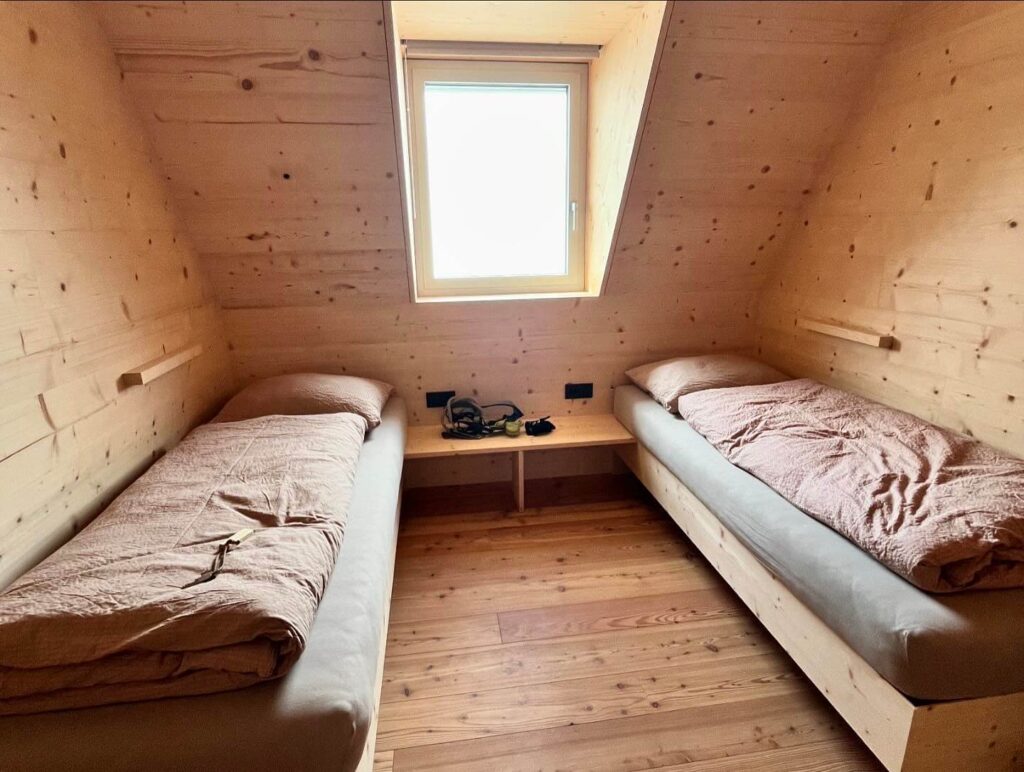
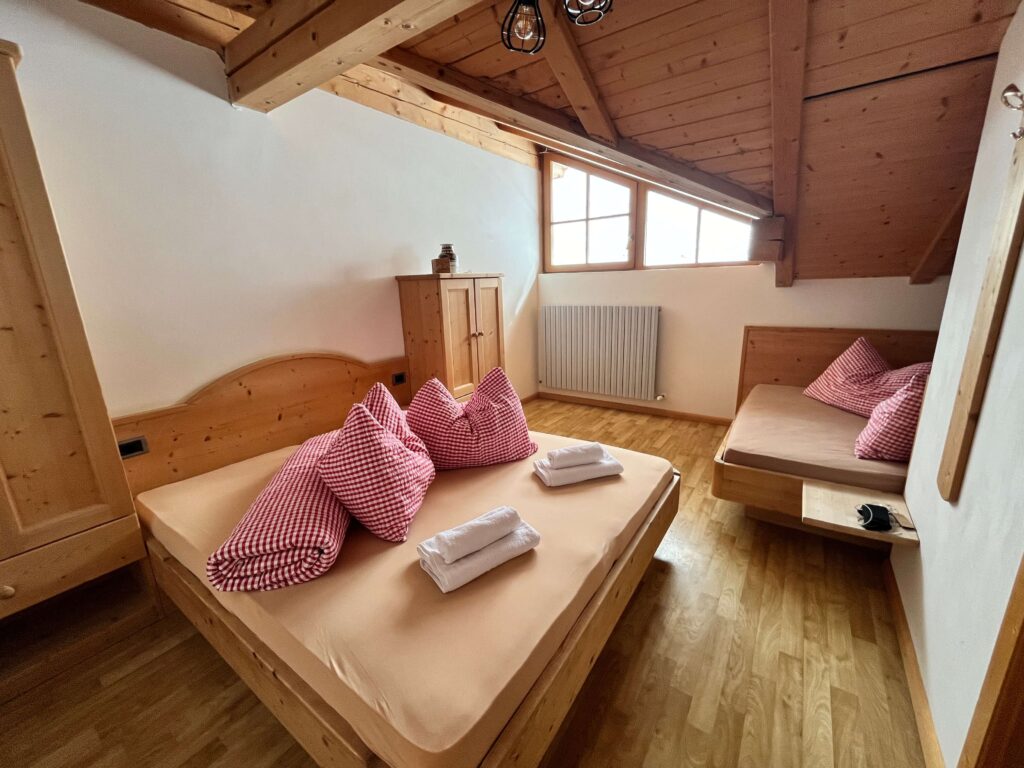
Since all huts chosen for this traverse offer excellent and authentic food as well as duvets for sleeping, your backpack will be very manageable. The huts feature running water and some of them even offer warm showers and double or 4-bed rooms.
Our base town will be either Canazei, Campitello di Fassa, Vigo di Fassa, Pozzain the Fassa Valley. Our via ferrata hut trek starts at the Sella Pass from where we will be traversing, always above treeline and close to the peaks, the entire Rosengarten range – the westernmost and, for some, the prettiest range of the Dolomites.
We can adjust the program on a daily basis should the preferences of the group change or the weather and mountain conditions not comply. The area is suitable for early and late season trips, as the huts tend to open earlier and stay open longer in the fall than in all other areas in the Dolomites.
2026 Pricing
EUR €2360/ person
HIGHLIGHTS
- Small group sizes
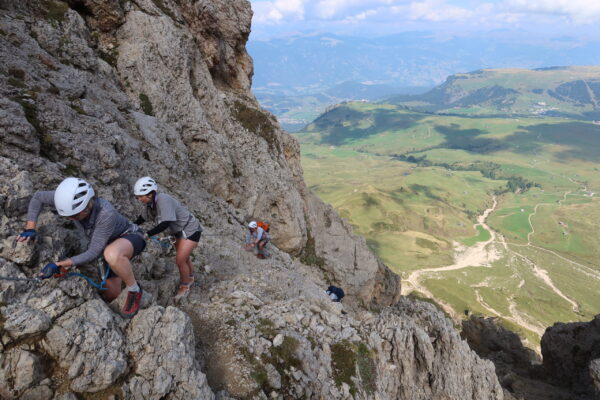
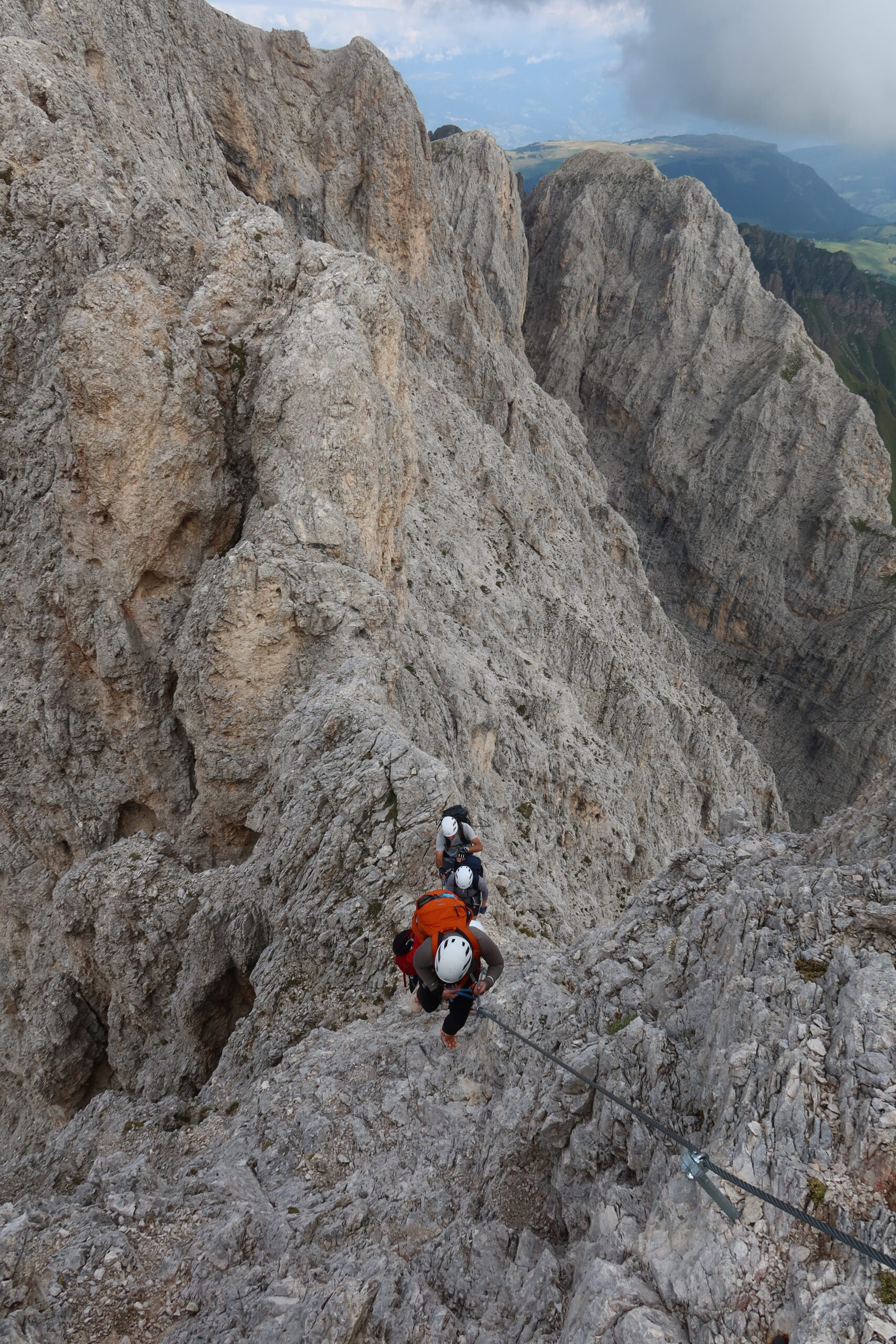
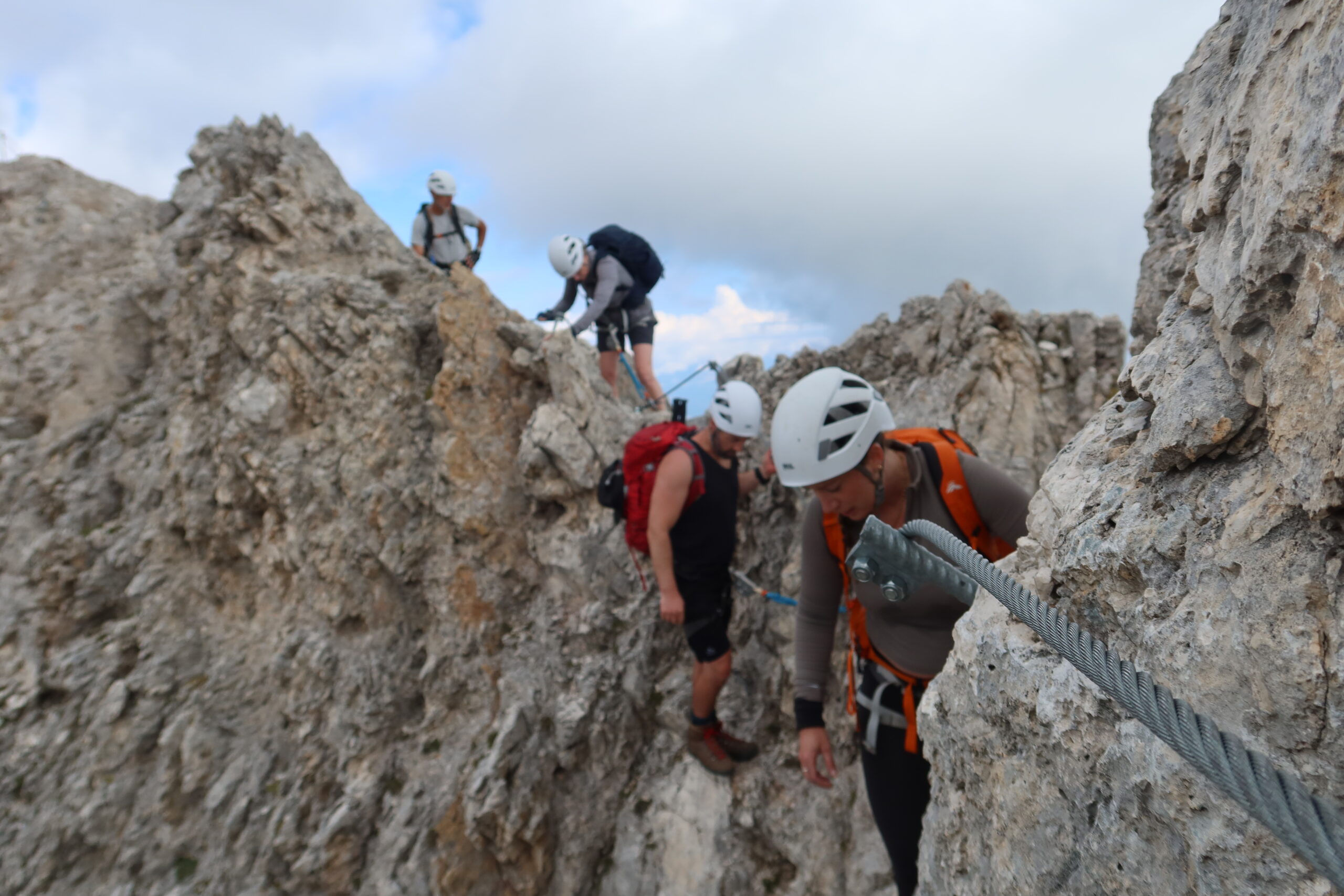
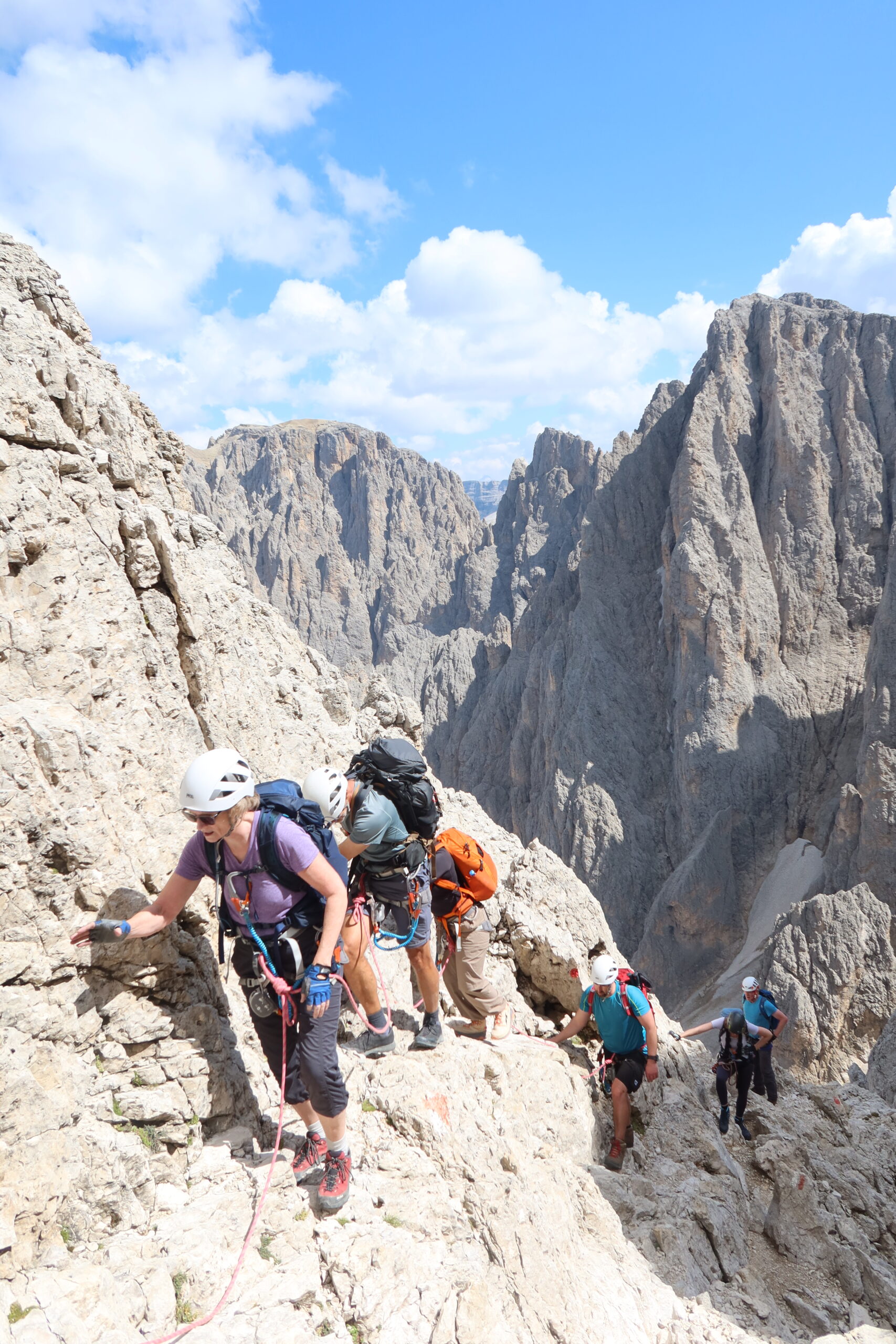
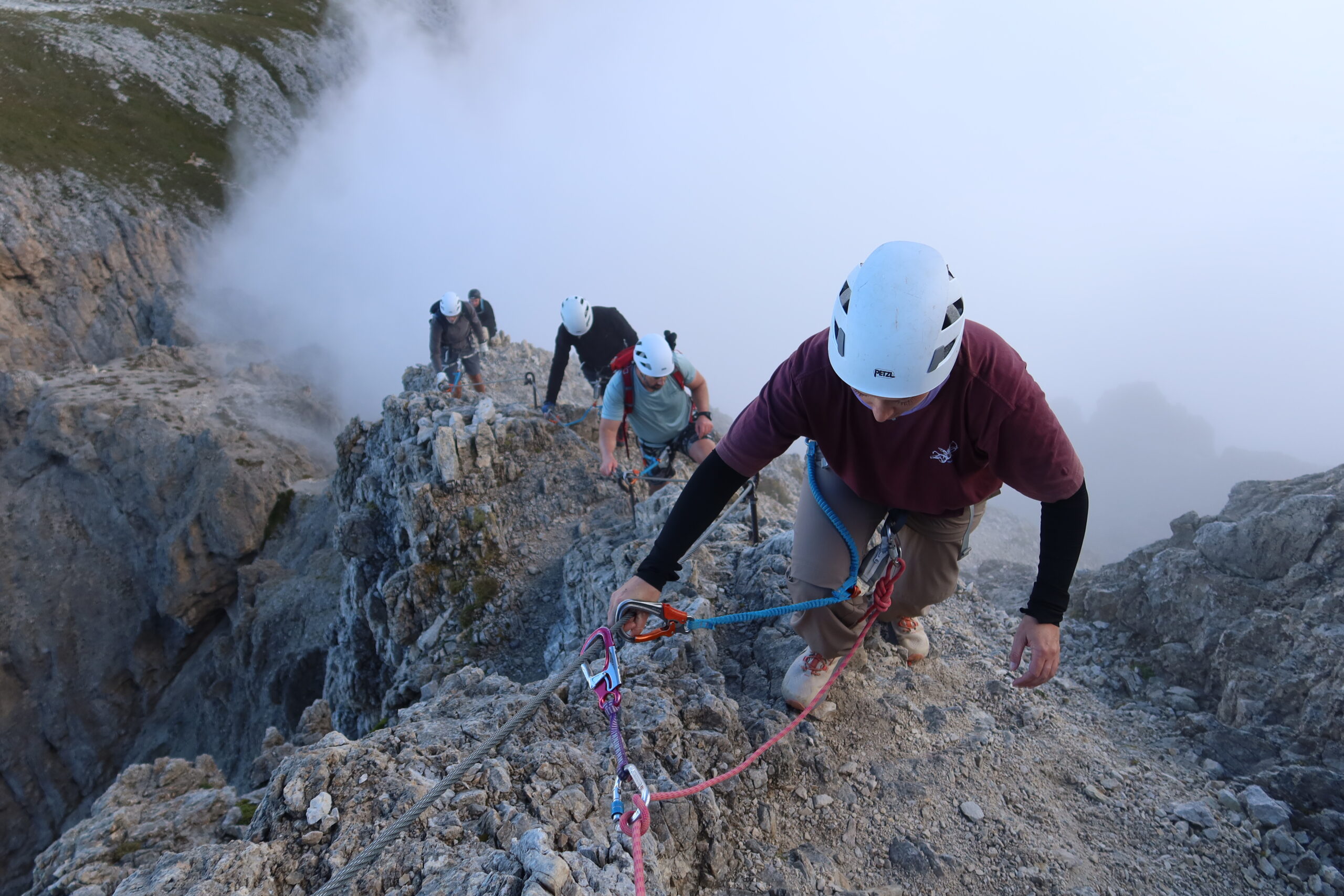
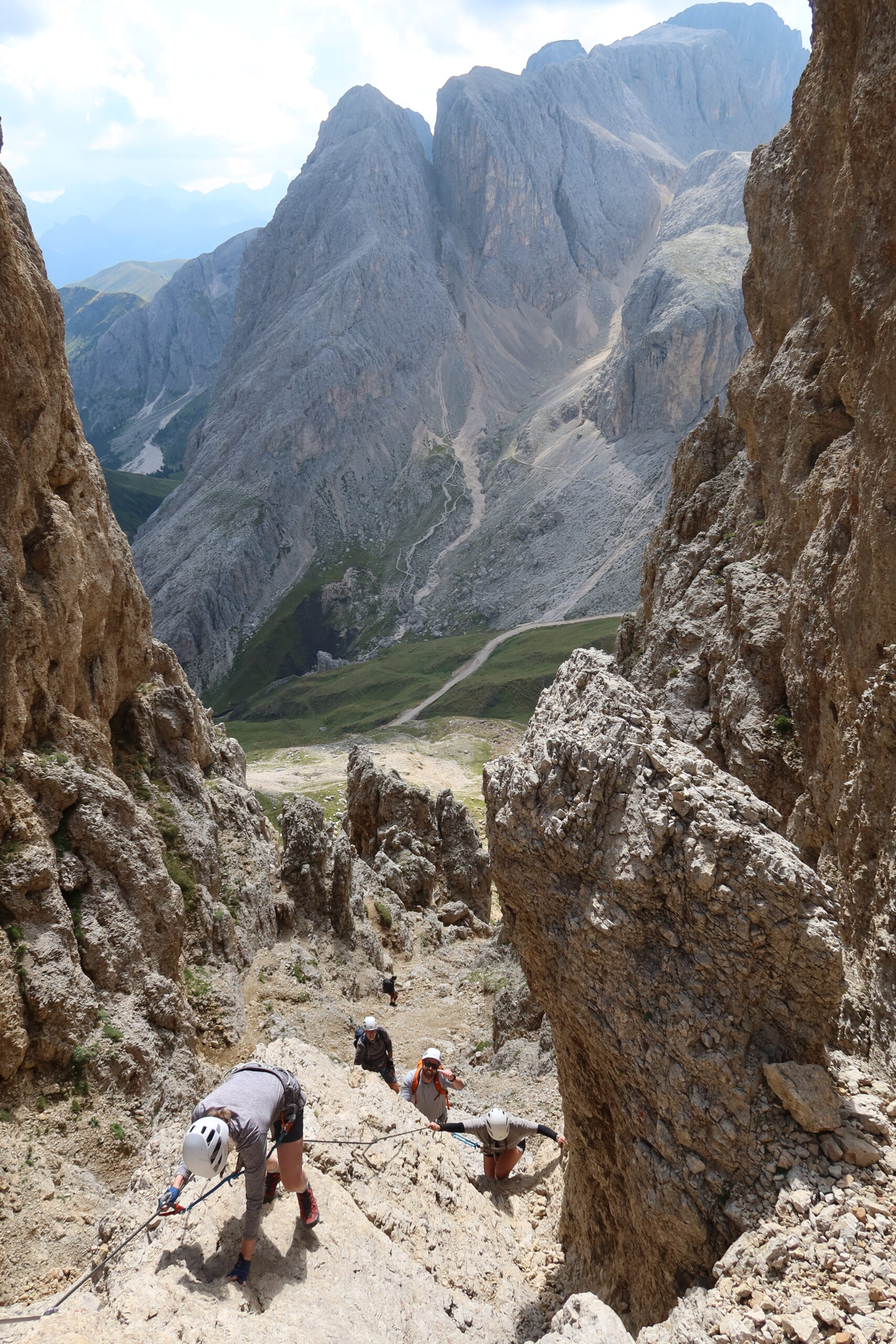
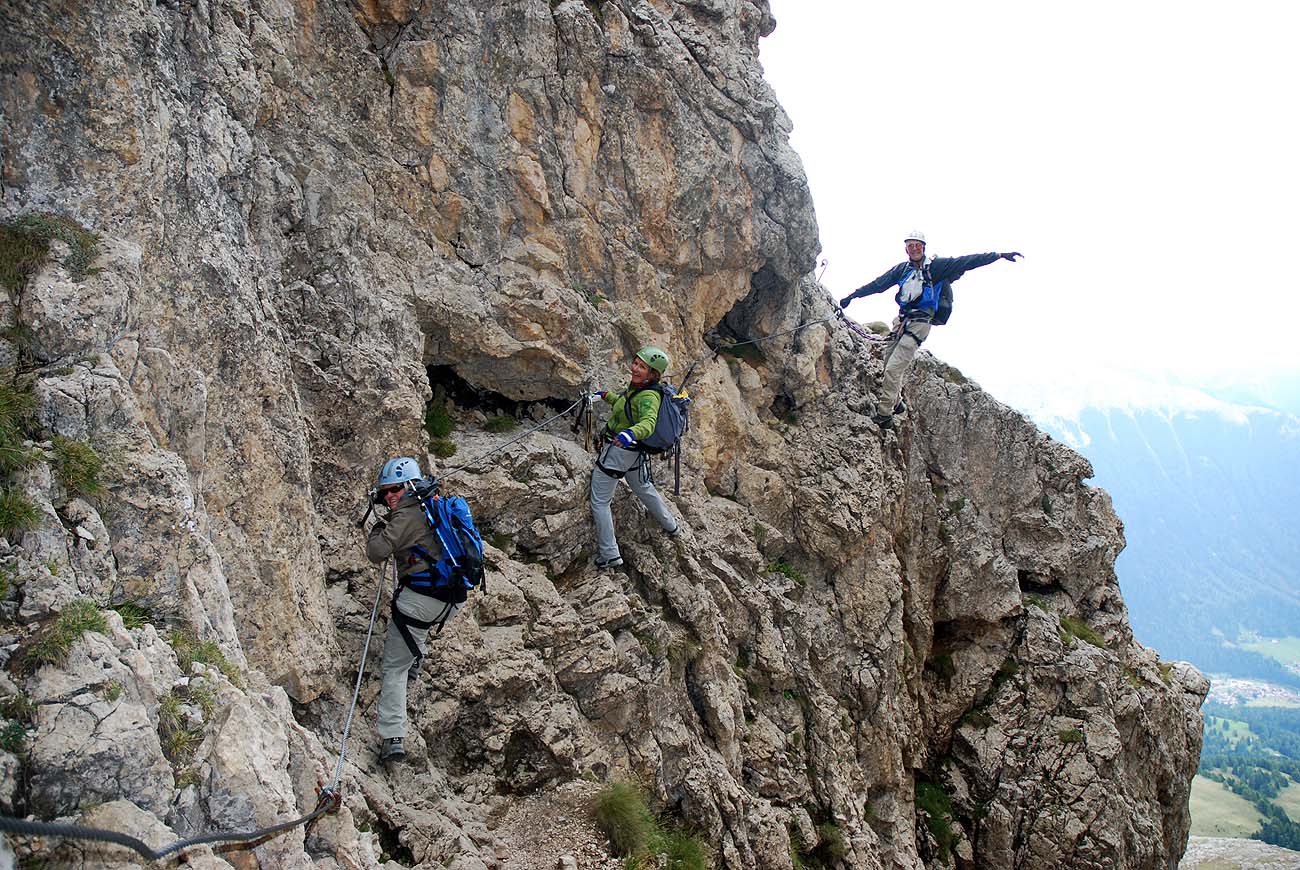
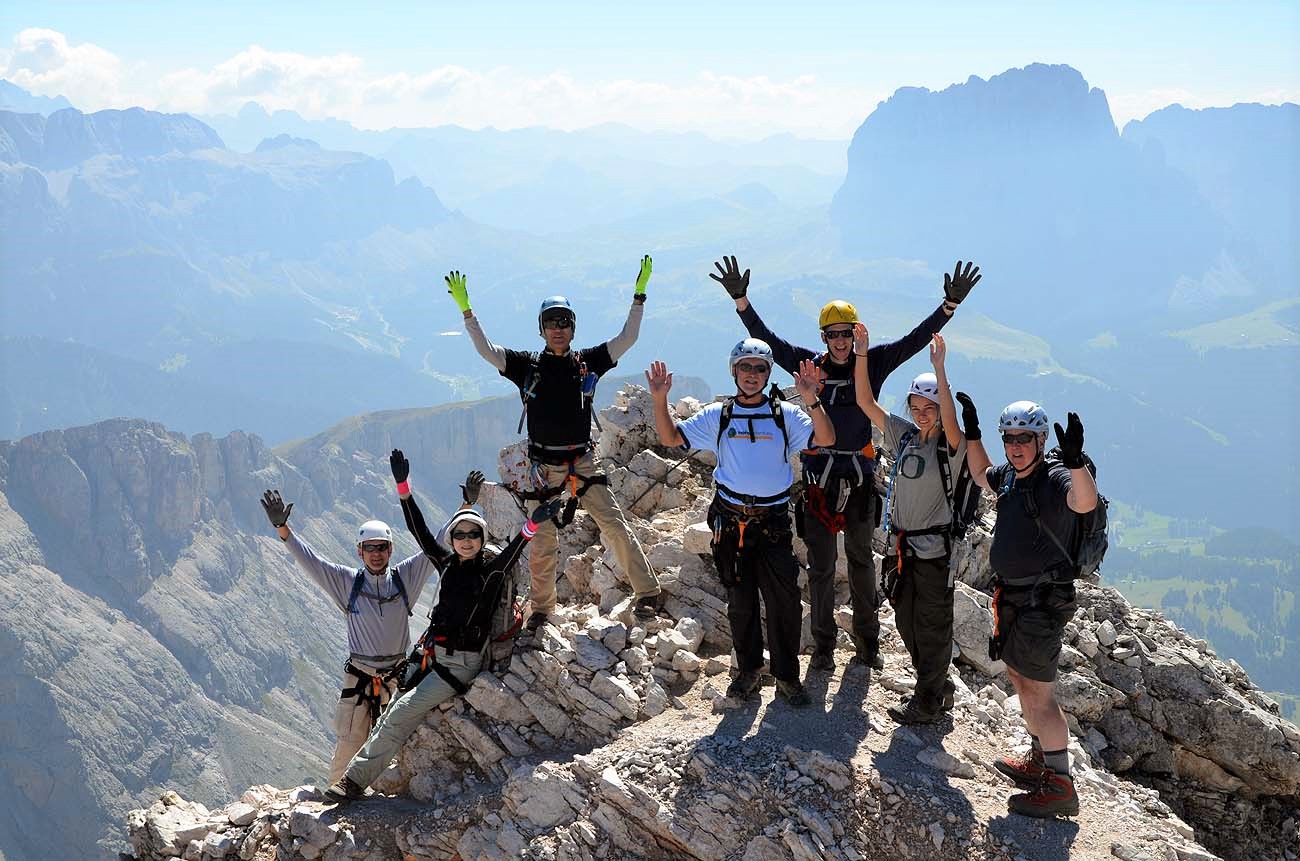
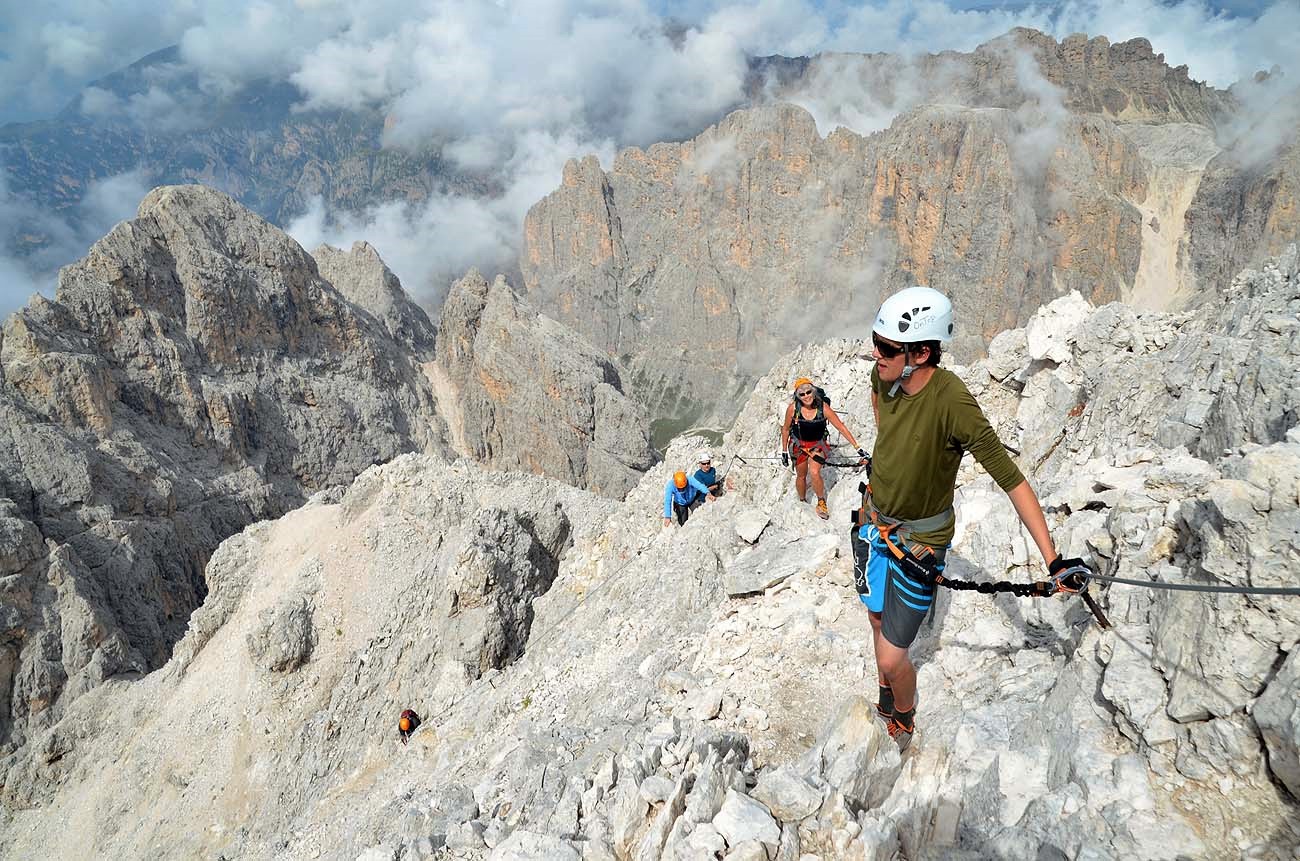
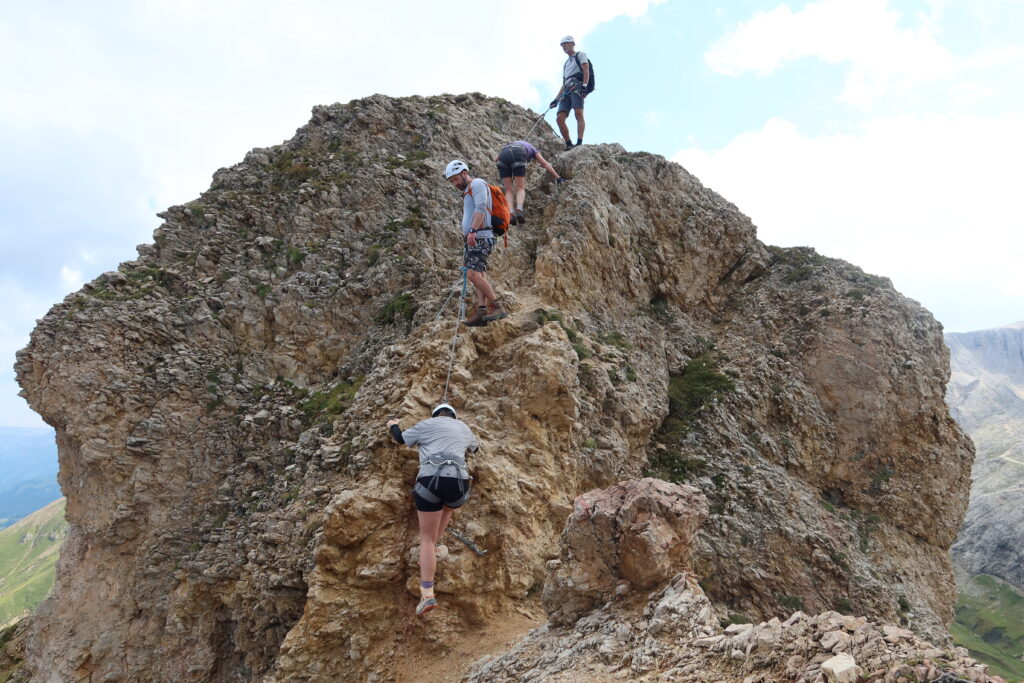
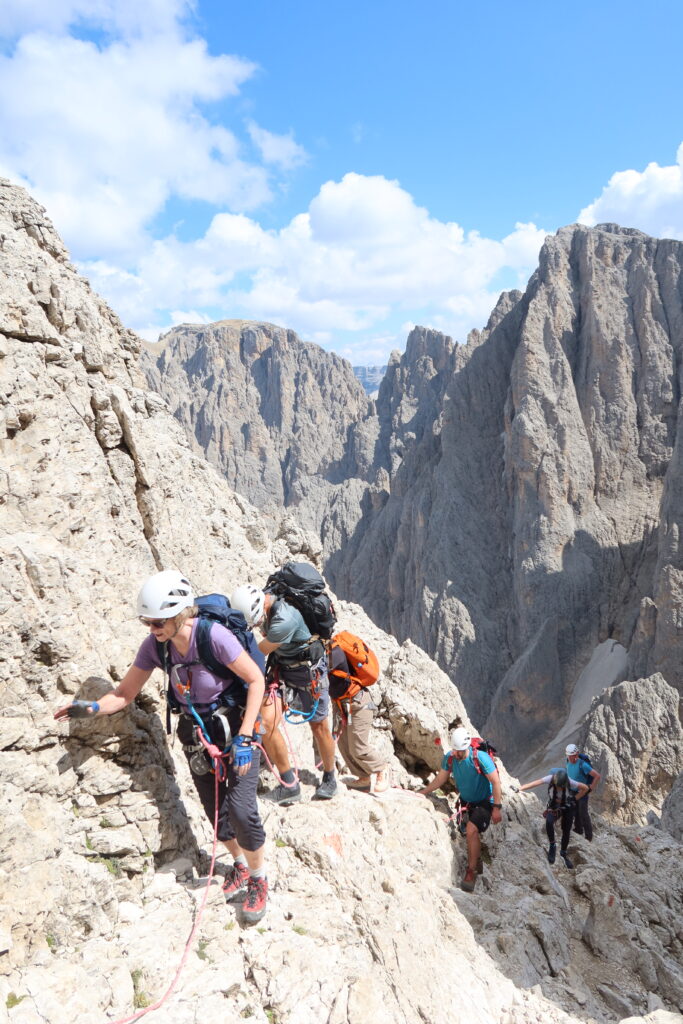
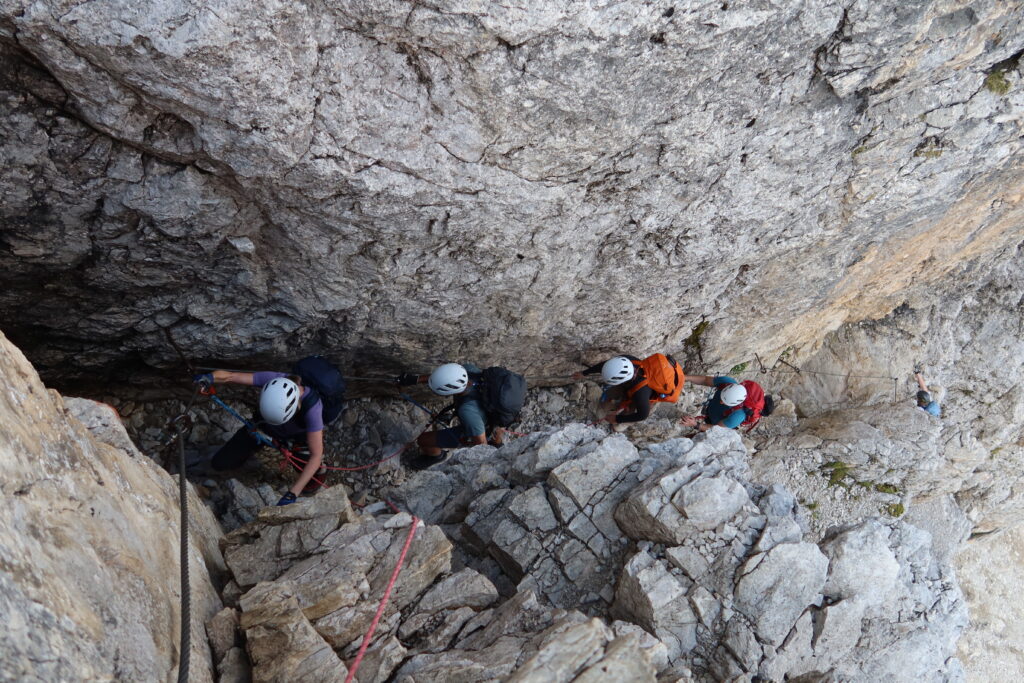
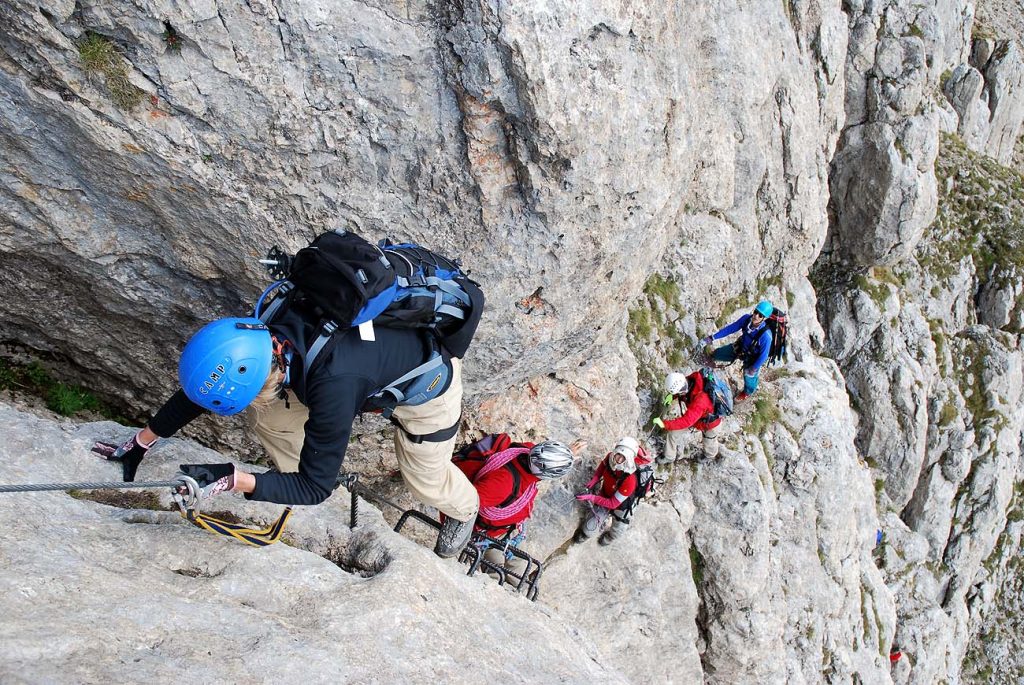
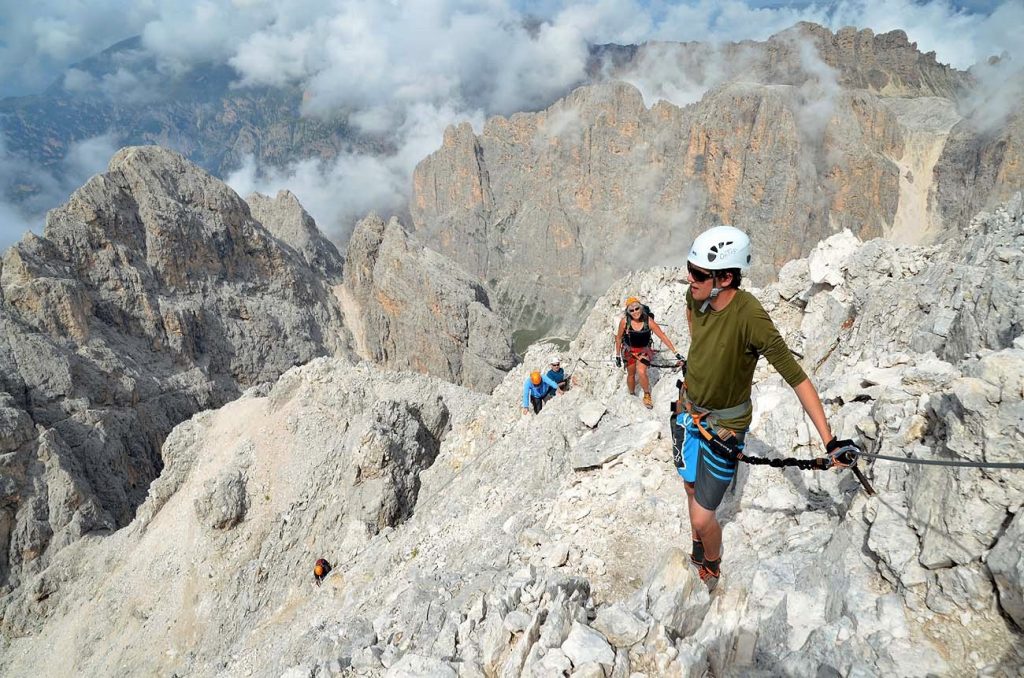
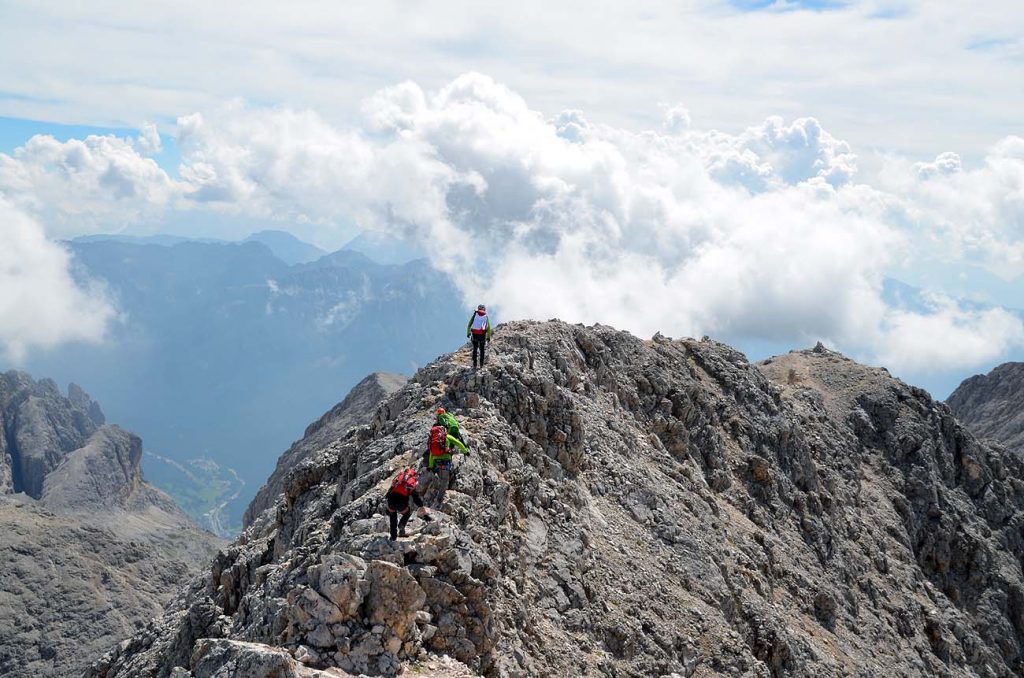
- Most panoramic via ferrata in the Dolomites
- Fully catered huts, most with showers & private rooms
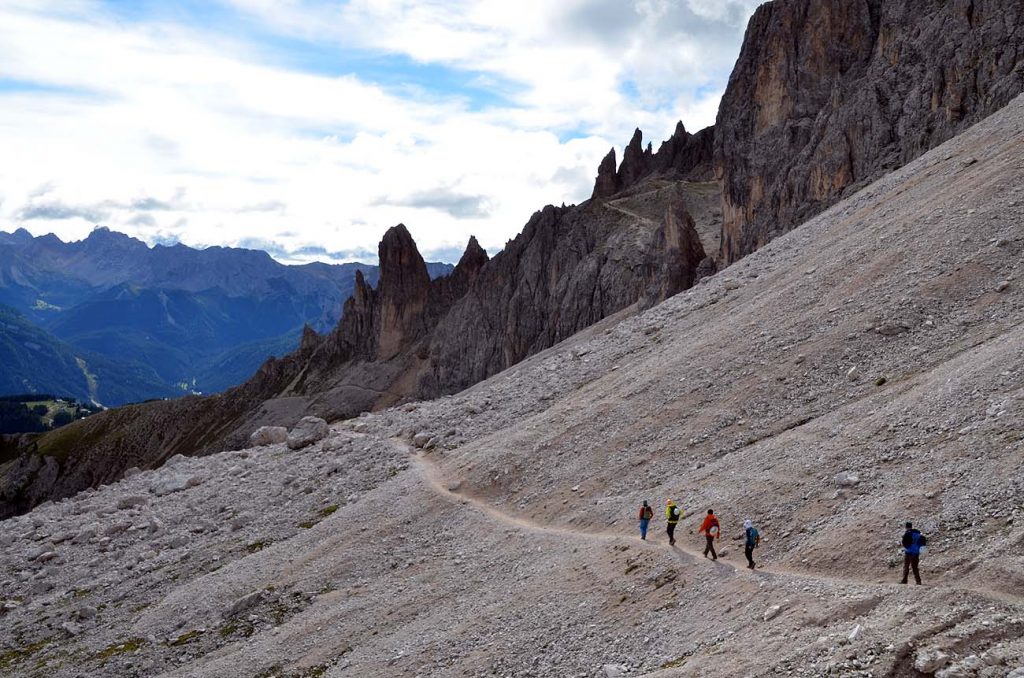
- High-level traverse – not too much up and down
- Daily option: via ferrata or trail hike
- Italian and Tirolian cuisine, history and cult
DIFFICULTY
- Up to 9 hrs/day
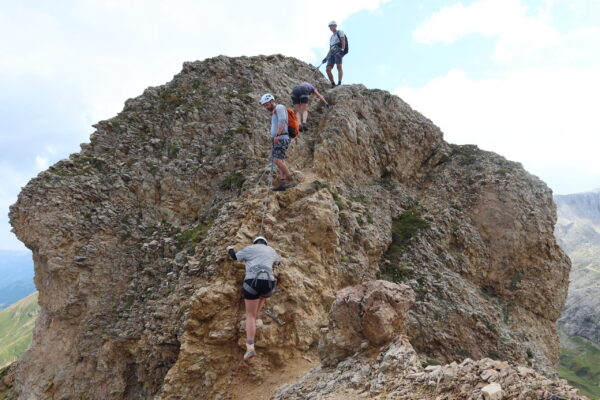
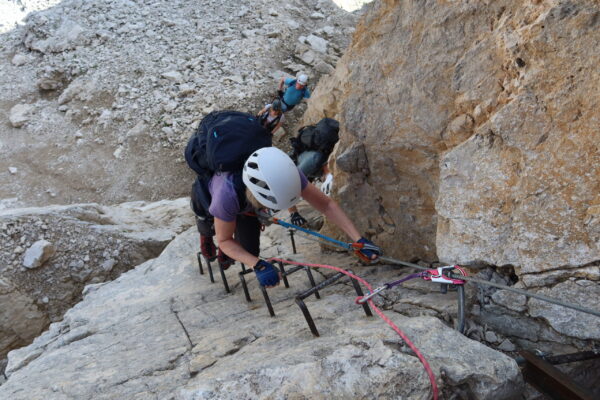
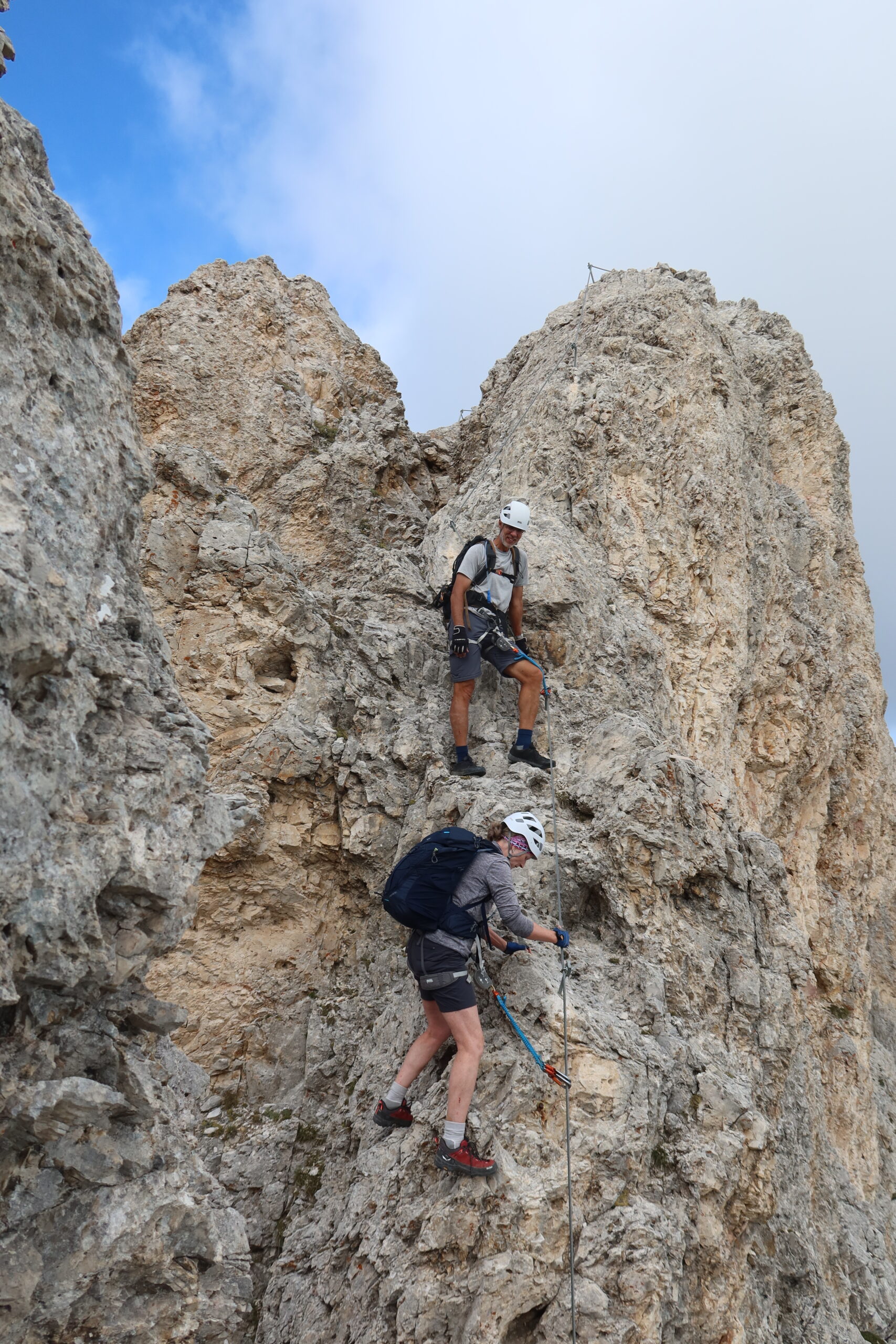
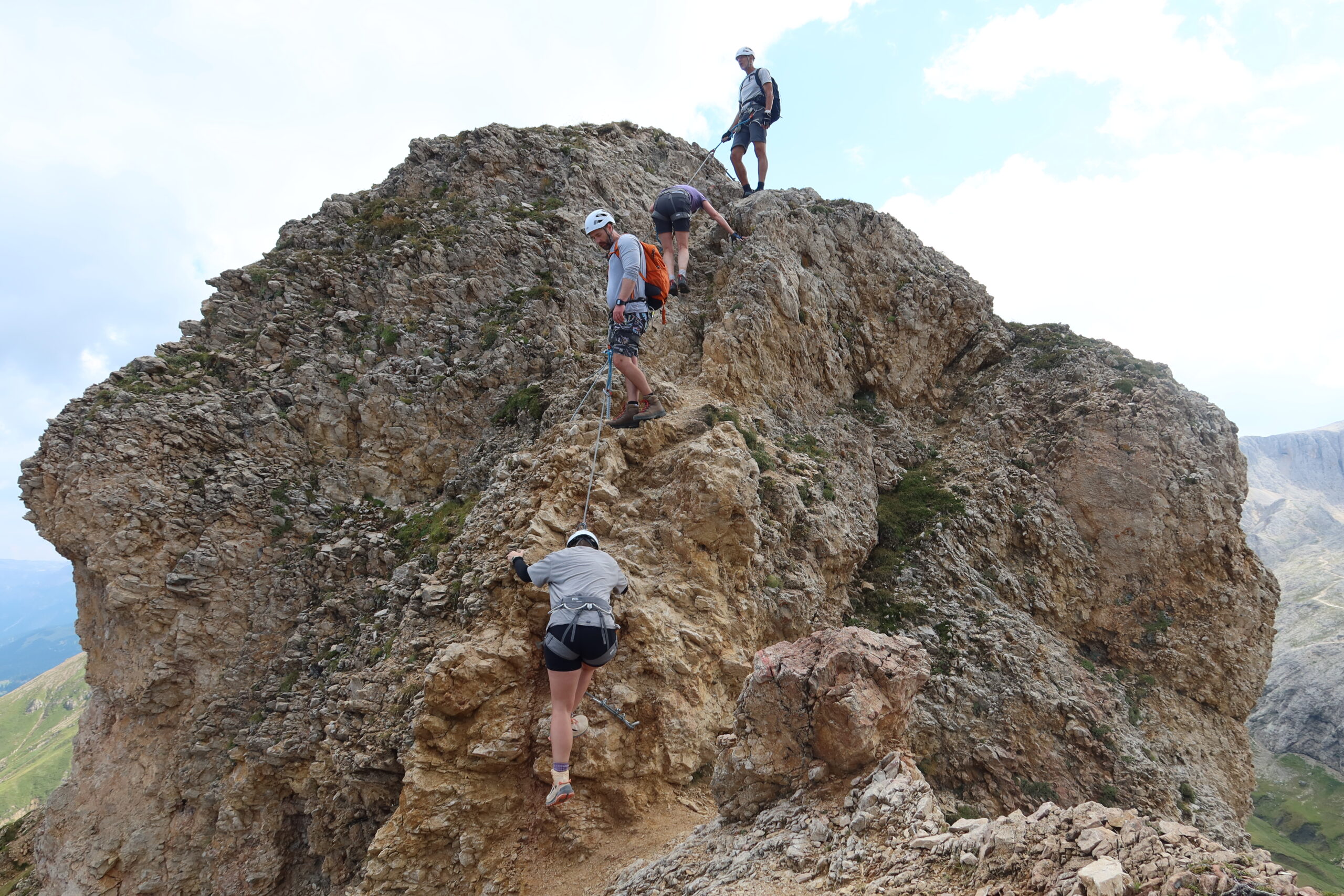
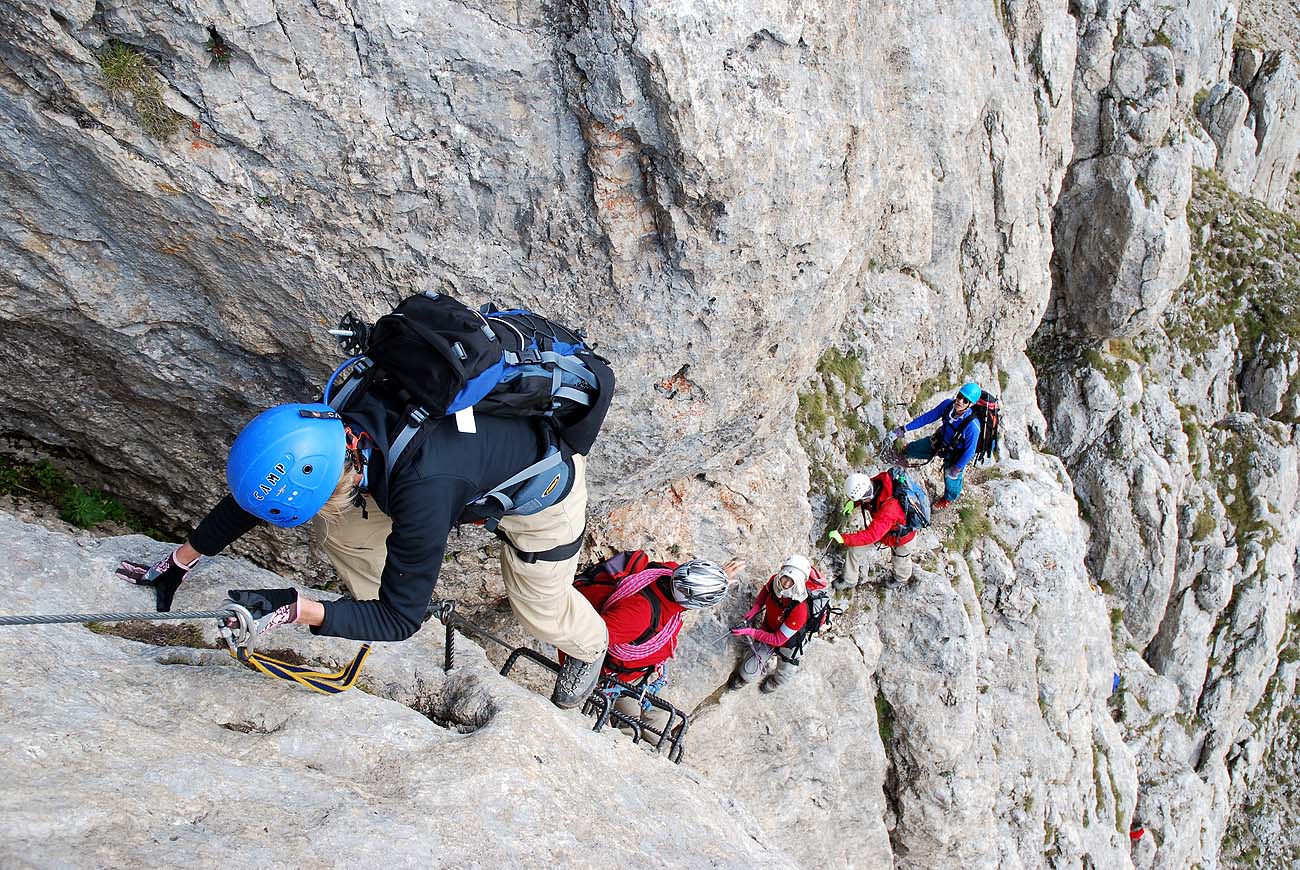
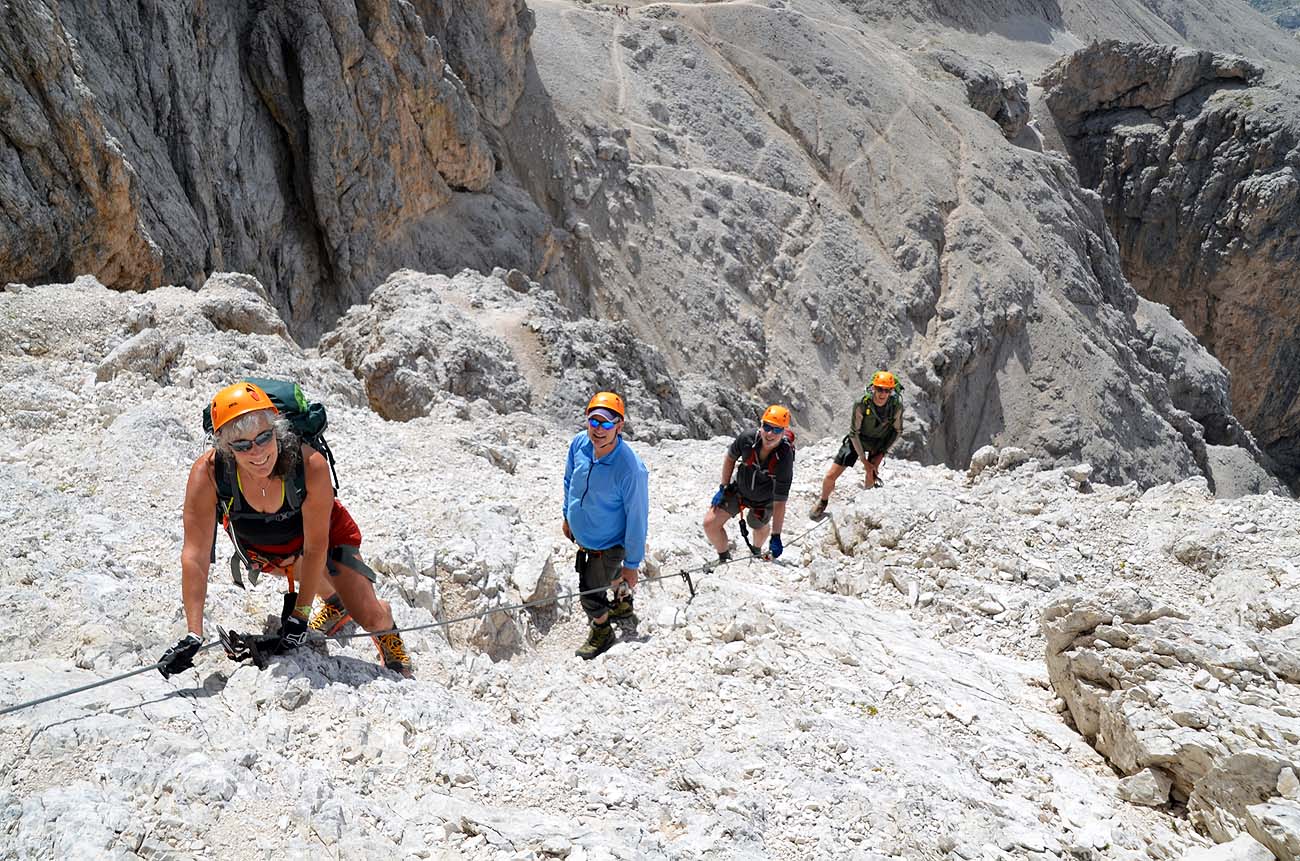
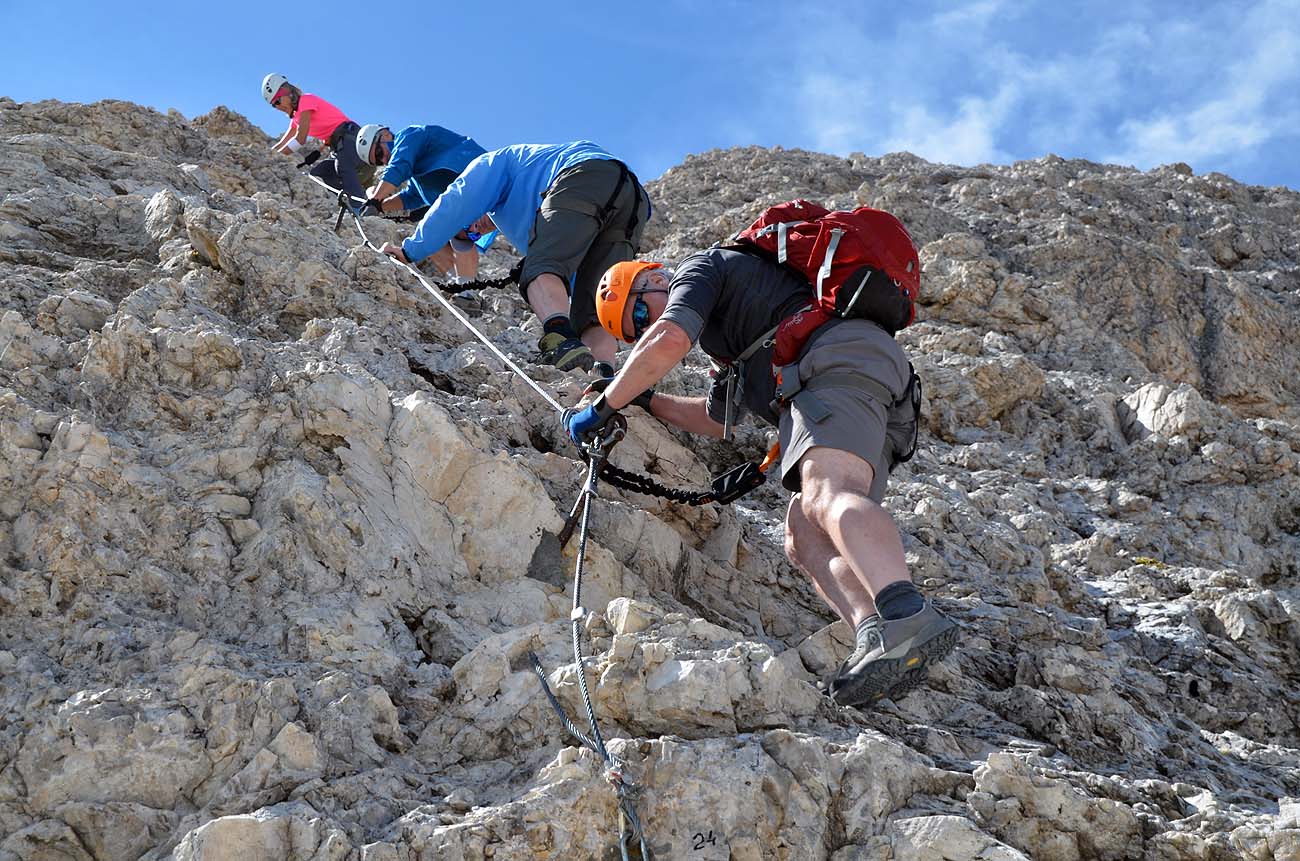
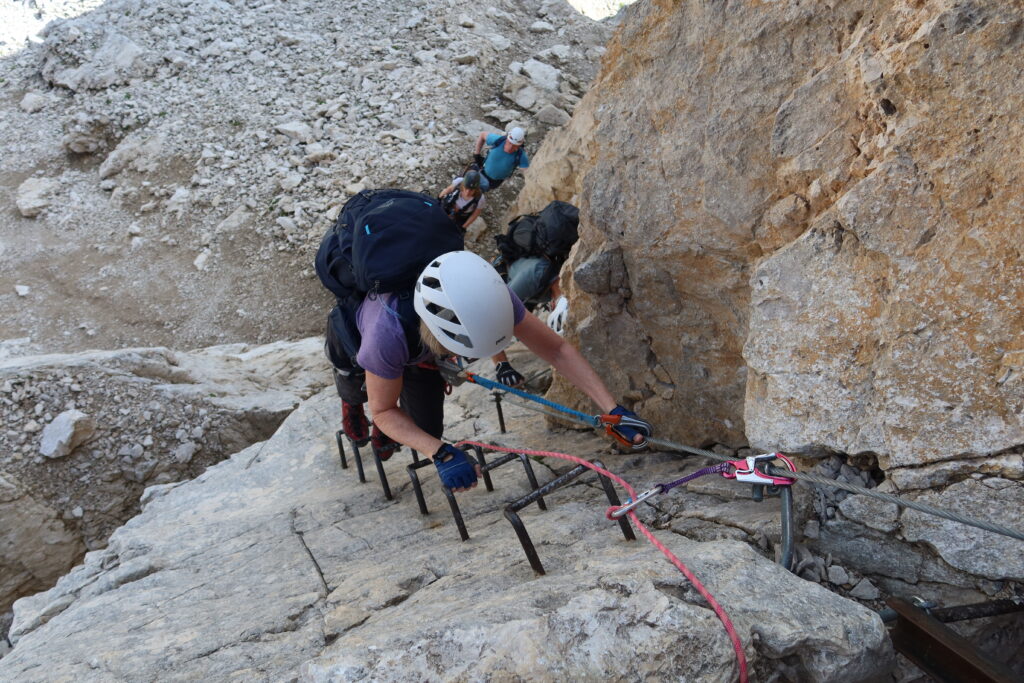
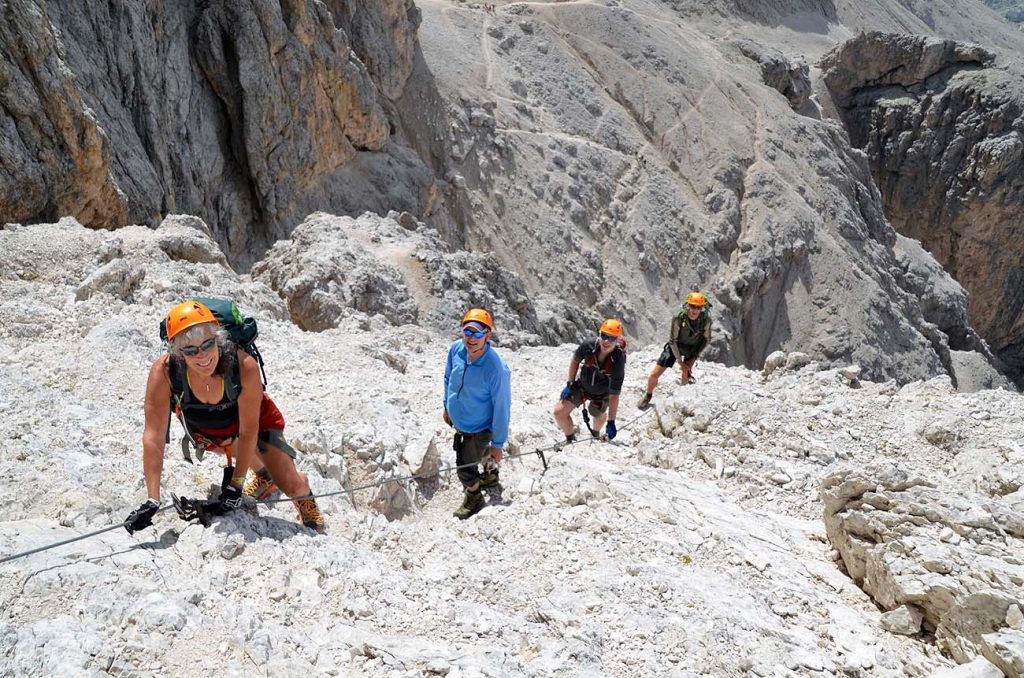
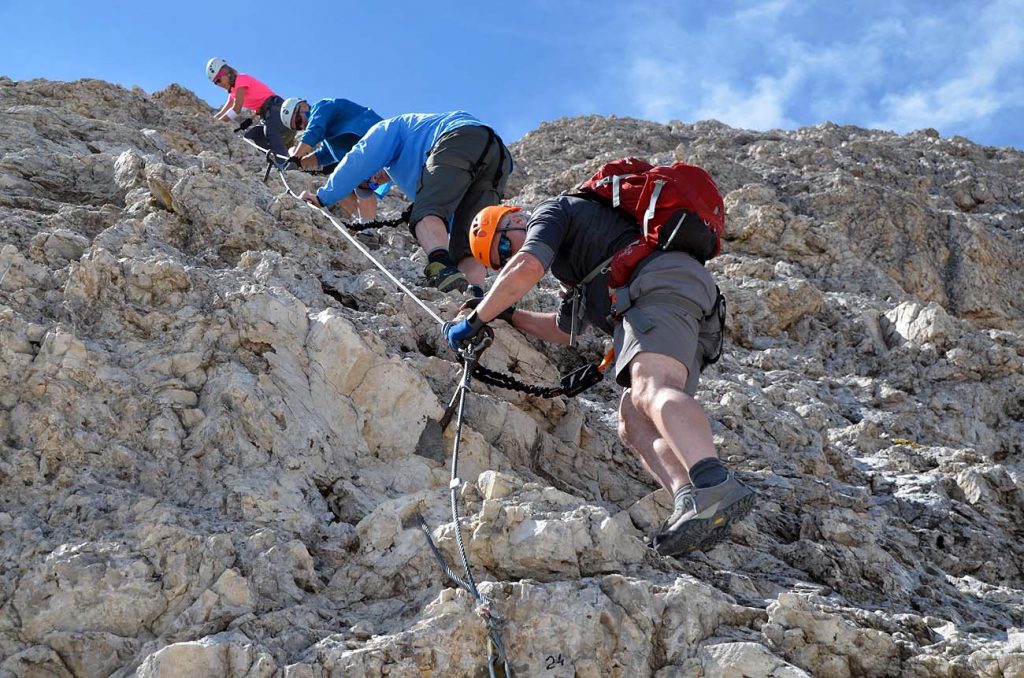
- Moderate via ferrata
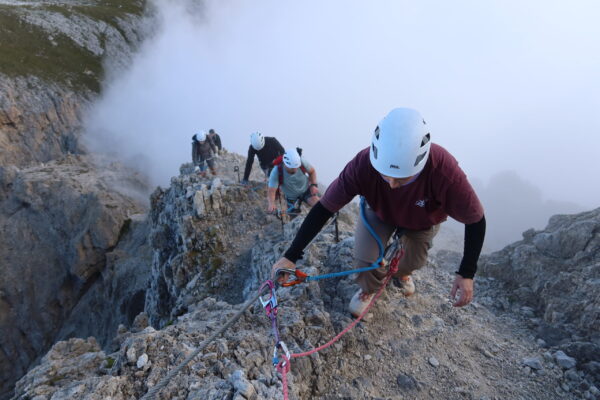
- Exposed trail sections
- Light multi-day packs
- Many itinerary options
Rosengarten Via Ferrata Itinerary
Please note: Due to the lack of a generally accepted grading system for via ferrata (every via ferrata guide book has its own grading system), we describe the via ferrata used in this itinerary with general terms for difficulty and duration as well as indicate the time commonly required. Judging how long a via ferrata takes by merely the vertical and horizontal distance that is being travelled can be hugely deceiving as it may take several hours to travel a kilometre on a via ferrata while on a good hiking trail, it usually takes 15 minutes, not to mention if conditions are adverse. We describe some but not all of the trip options available depending on the participant’s abilities and preferences as well as weather and mountain conditions at the time.
Please keep in mind that the following program may have to be adjusted to group abilities and preferences, weather and mountain conditions at the time at the discretion of the guide.
Arrival/ Travel Day:
Arrive in Canazei in the Fassa Valley by public transportation (scheduled buses from Bozen / Bolzano main station) or rental car & settle into the hotel. Please use this day to pack your trekking bag and prepare a lunch for Day 1 of the itinerary.
Rosengarten / Catanaccio Hut to Hut Traverse
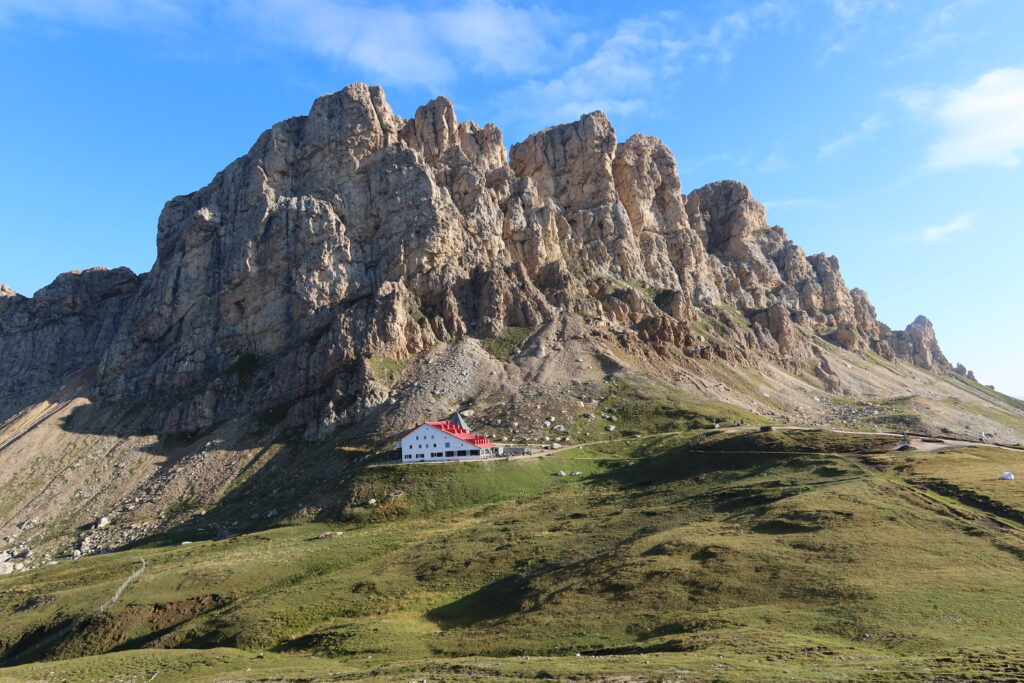
Day 1: Passo Sella – Oscar Schuster Klettersteig – Plattkofel Peak – Plattkofel Hut / Rifugio Sasso Piatto
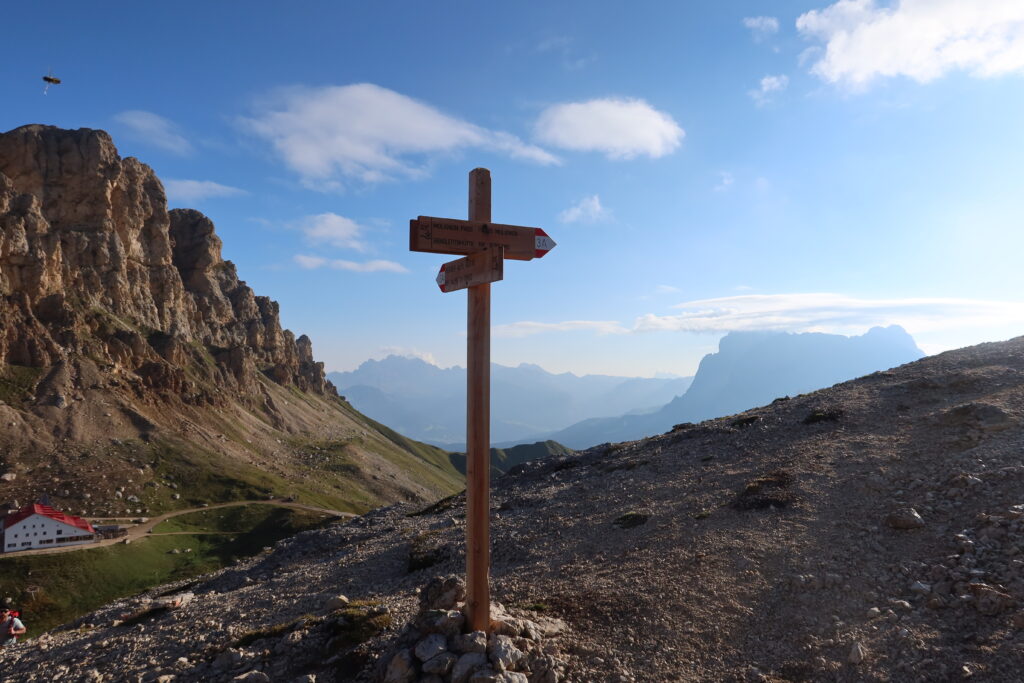
After breakfast, meet your guide for a trip briefing and distribution of rental gear. 15 min drive to the Sella Pass (2160m ), from where we have several options to reach the Plattkofel Hut / Rifugio Sasso Piatto (2300m ):
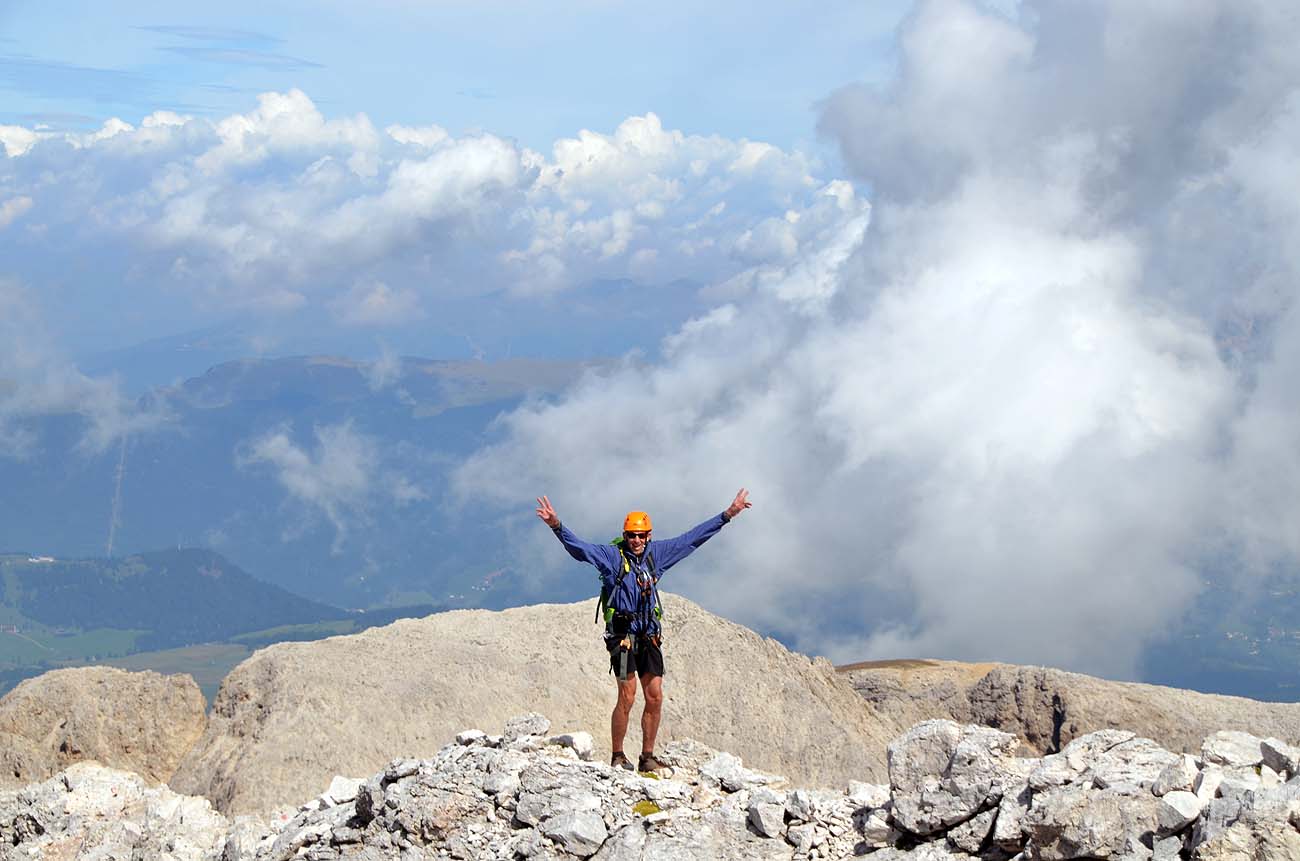
a) Gondola ride to the spectacular Langkofel / Sassolungo Notch (2680m )Via Ferrata Oscar Schuster to the summit of the Plattkofel / Sasso Piatto (2960m ), to enjoy one of the best views of the Western Dolomites. Descent to the Plattkofel Hut / Rifugio Sasso Piatto (2300m ).
b) In times of snow coverage during the early or late season, the Col Rodella via ferrata offers a shorter but beautiful and usually dry via ferrata facing south followed by a panoramic high-level trail (Friedrich August Weg) to the Plattkofel Hut / Rifugio Sasso Piatto (2300m ) 6 hrs.
c) The Plattkofel Hut / Rifugio Sasso Piatto (2300m ) can also be reached by two scenic non-technical hiking trails on either side of the Langkofel / Sassolungo
700m = 2,300ft climb, 1070m = 3,500 ft descent, 5.8km= 3.6 mi distance. 6.5 hrs total for the day with about 3 hrs on the Oscar Schuster via ferrata.
Day 2: Maximilans Klettersteig / Via Ferrata – Tierser Alpl Hut
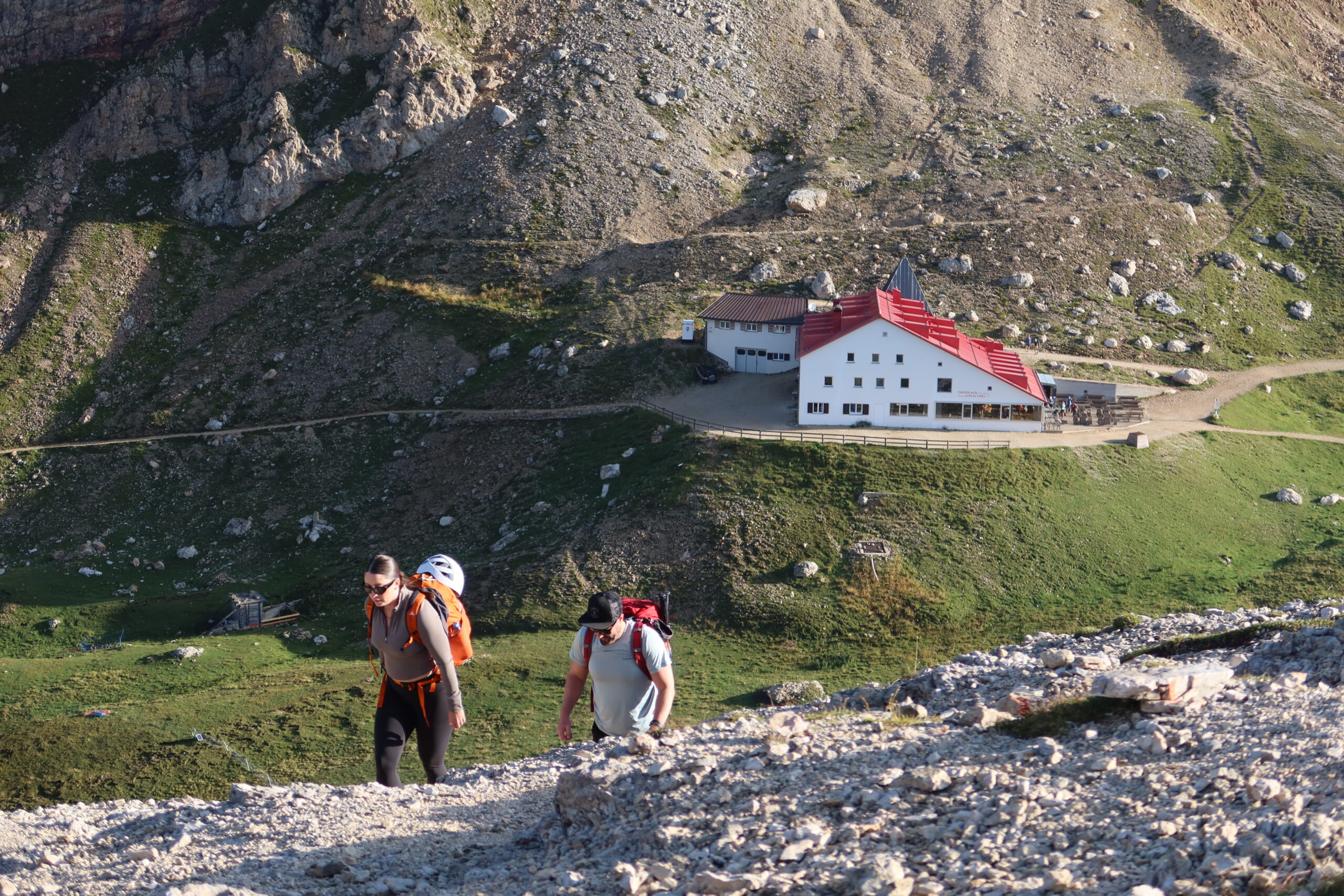
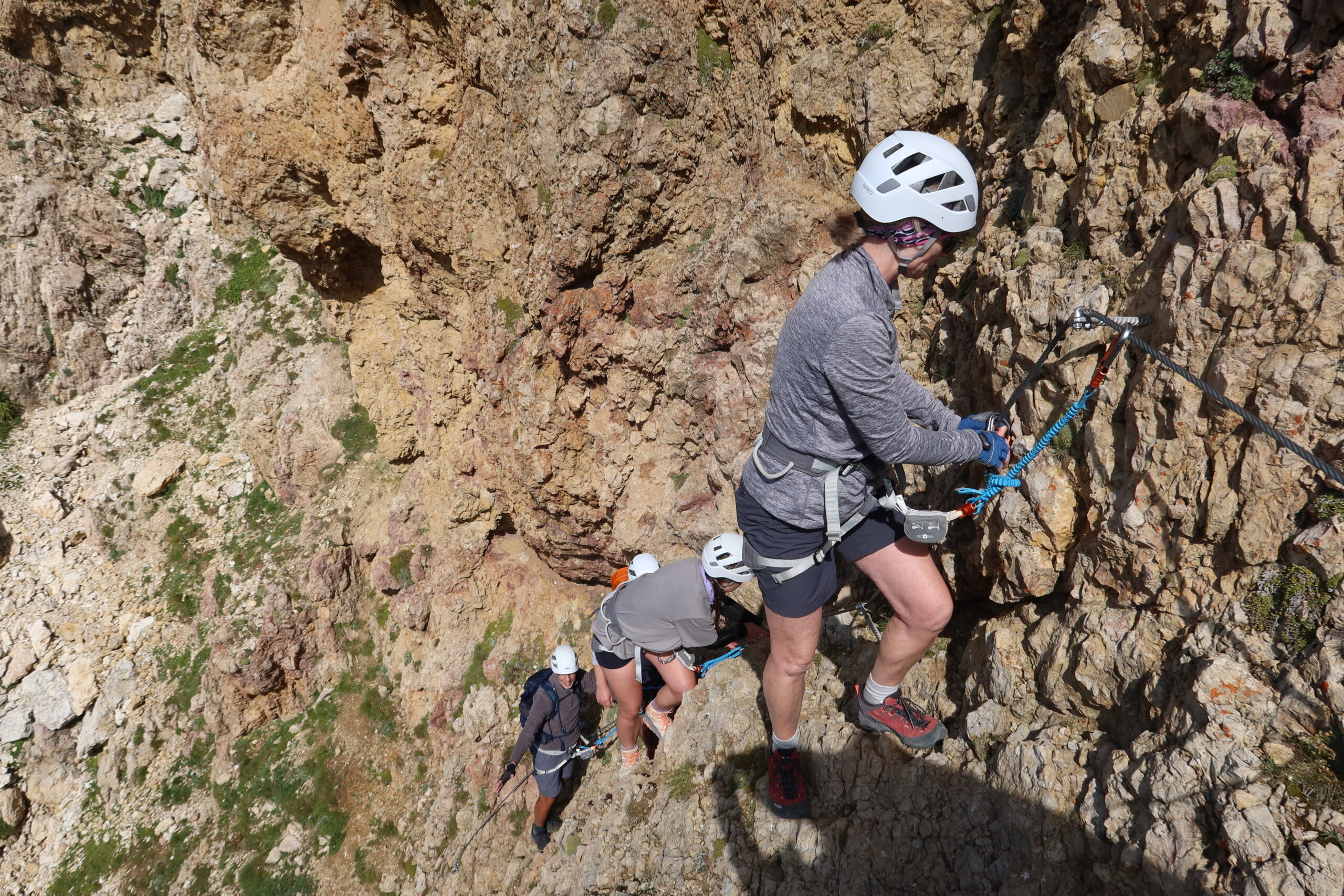
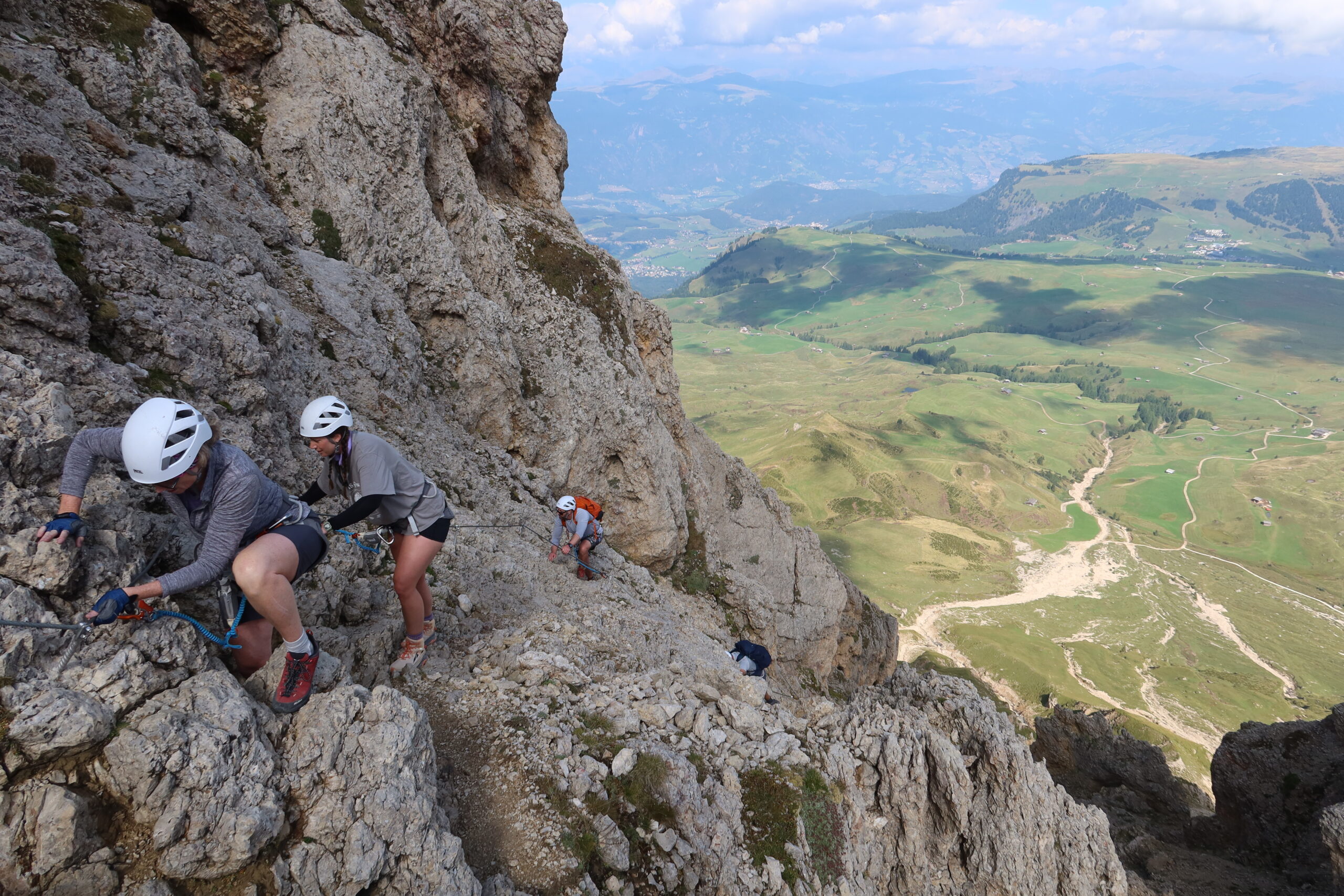
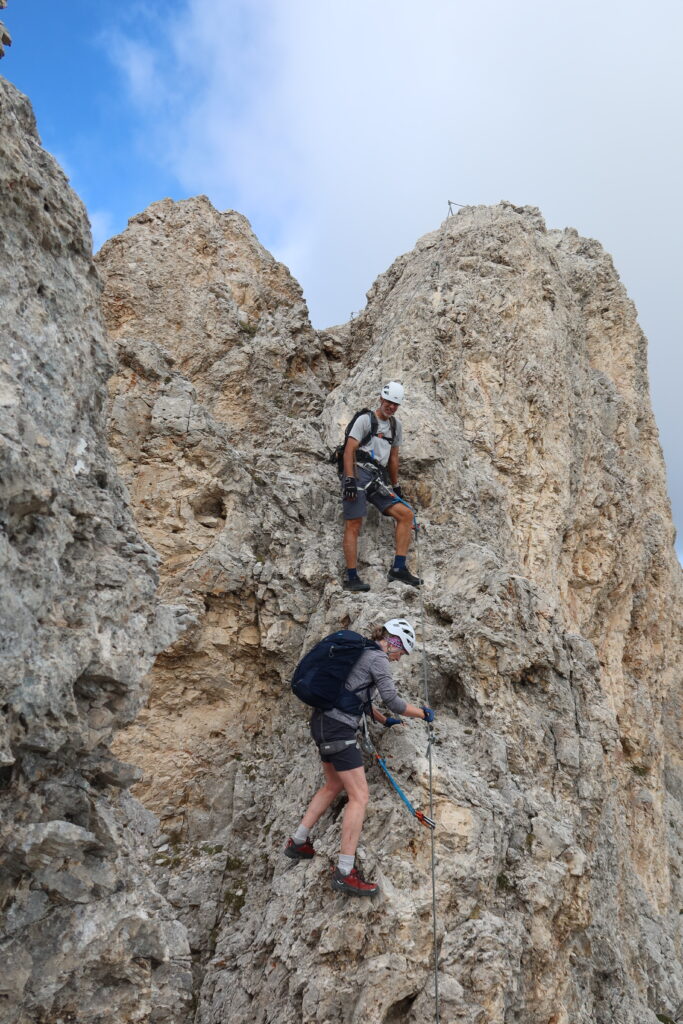
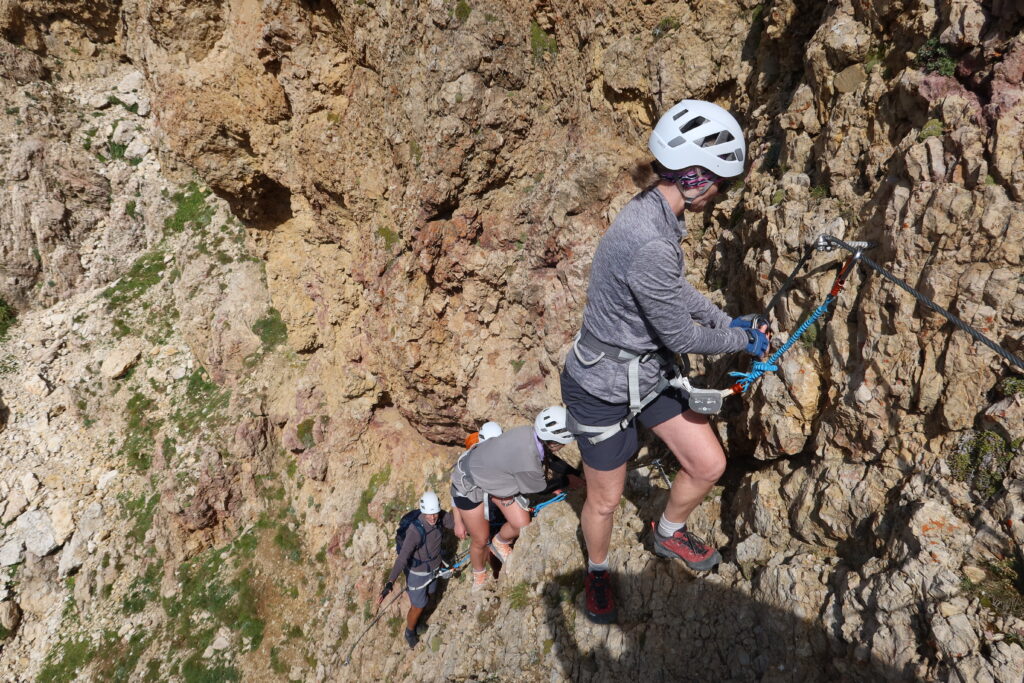
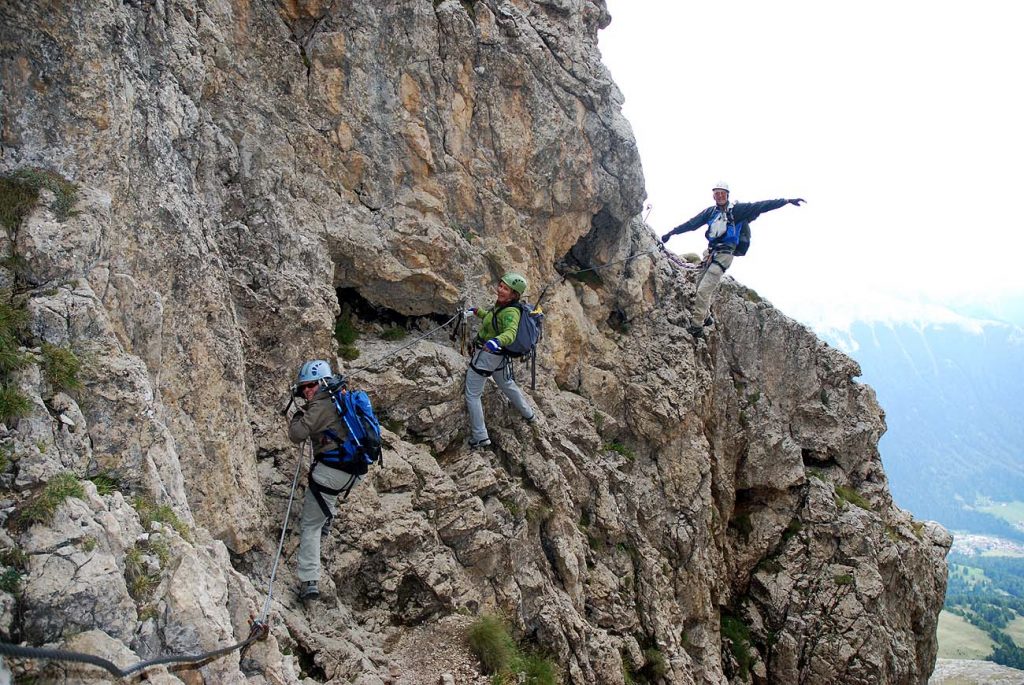
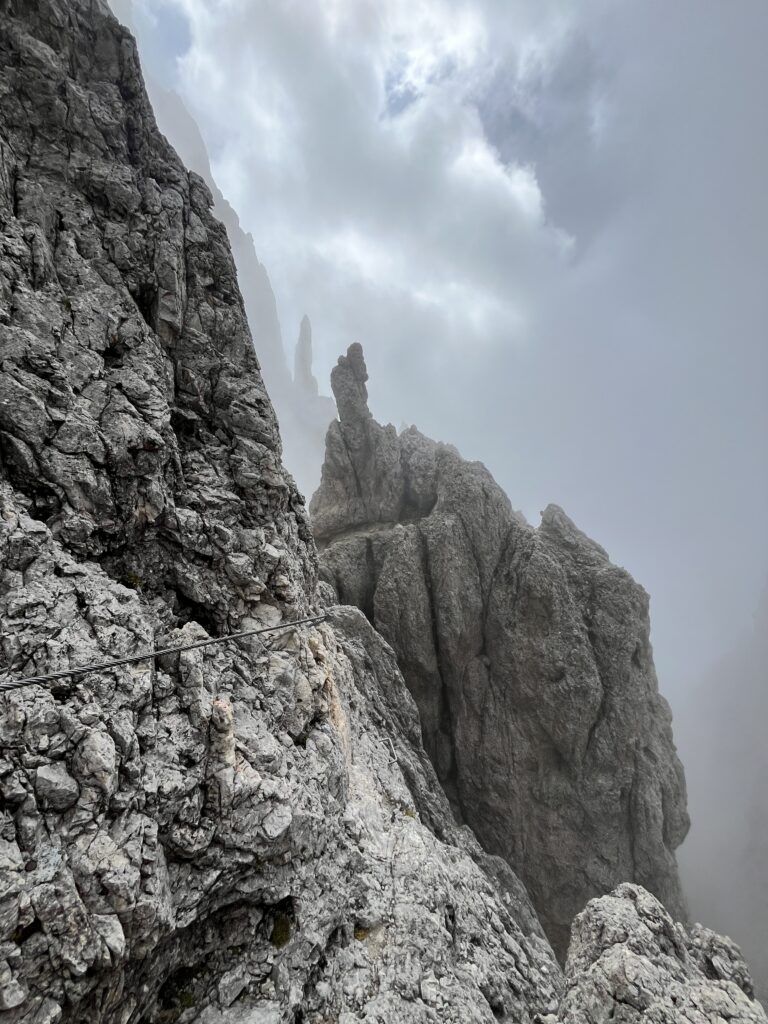
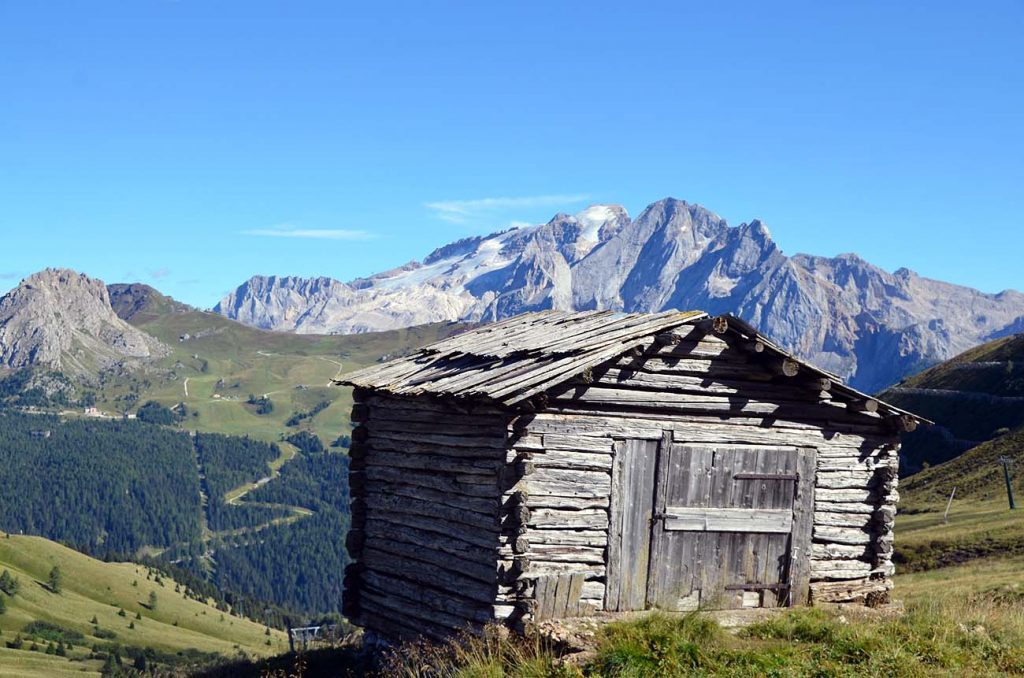
A beautiful panoramic trail with prime views of the highest and most glaciated peak of the Dolomites, the Marmolada, leads us to the Tirser Alpl Hut (2440m) in about 2.5 hrs, more of a mountain lodge than a hut with warm showers. With a light pack, we set off to traverse the “Rosszaehne” (horse teeth) and Roterdspitze (2690m) on the relatively easy but wildly exposed Maximilian Klettersteig / Via Ferrata and return in a loop back to the Tierser Alpl Hut for the night.
750m = 2470ft climb, 630m = 2080ft descent, 11km = 6.9mi distance including the full Maximiliansteig via ferrata, 6-7 hrs with options to shorten the via ferrata.
Day 3: Laurenzi Via Ferrata – Antermoja Hut – Rifugio Passo Principe / Grasleitenpass Hut
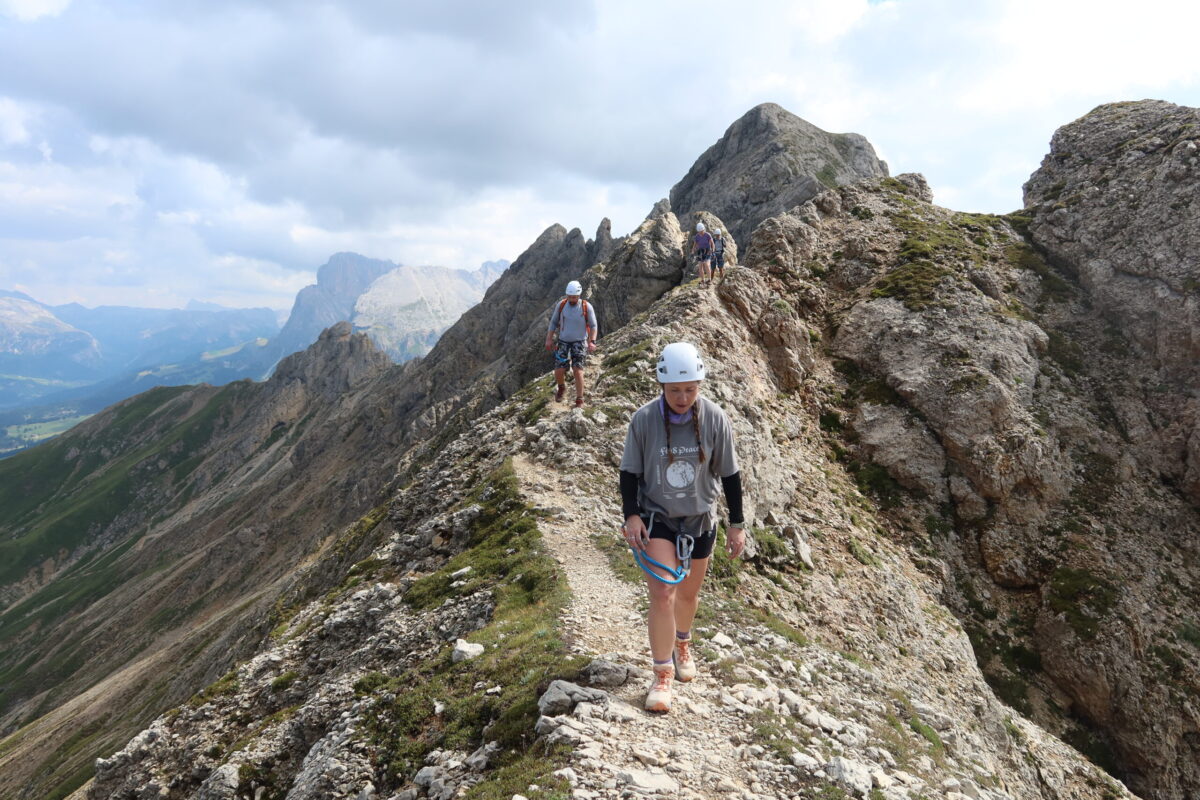
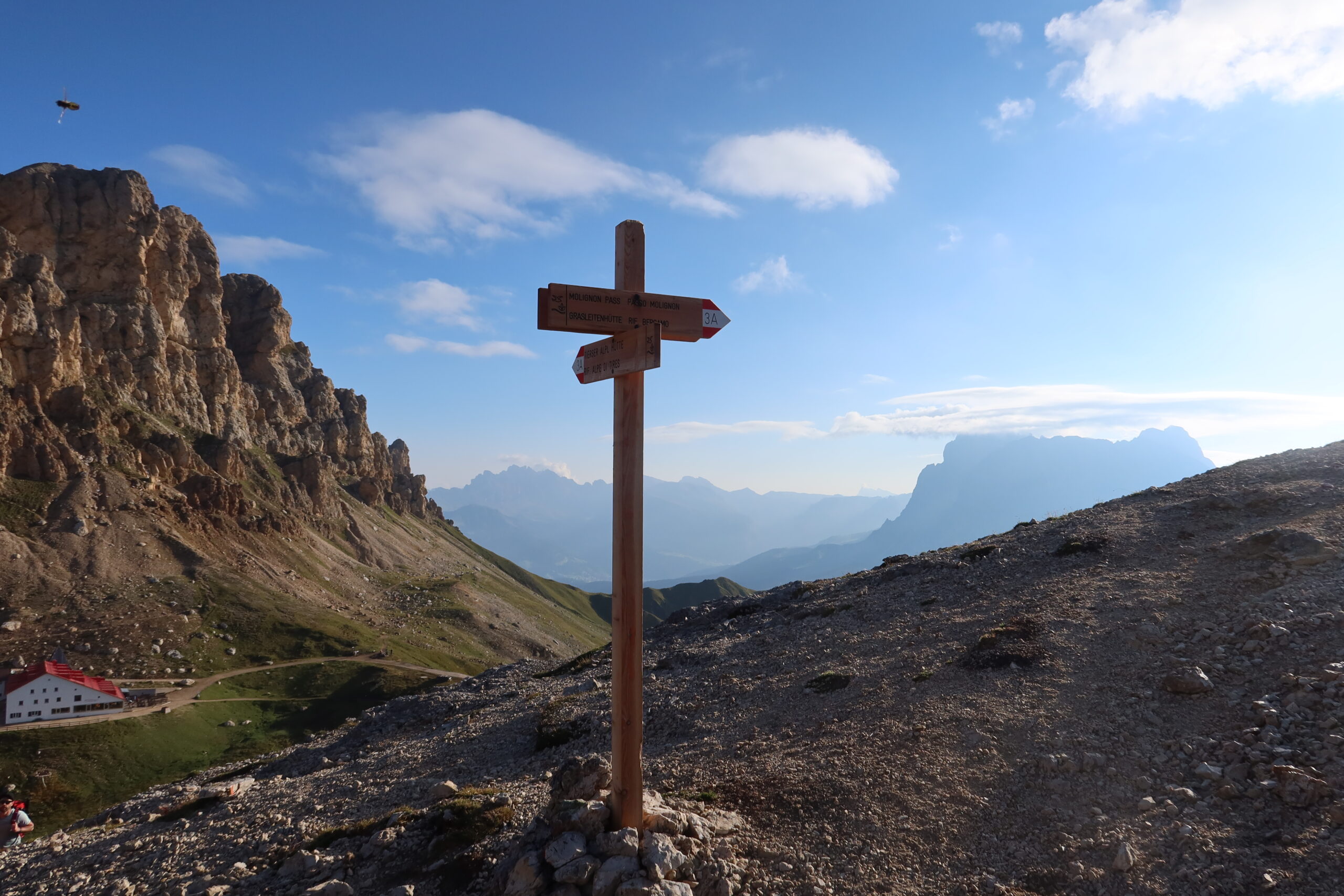
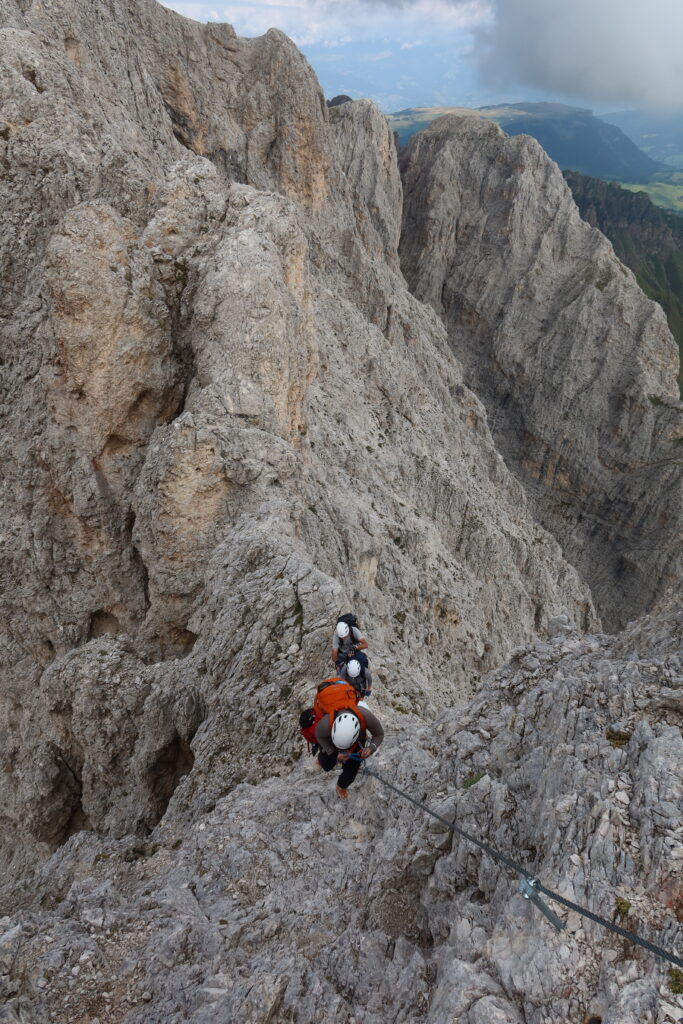
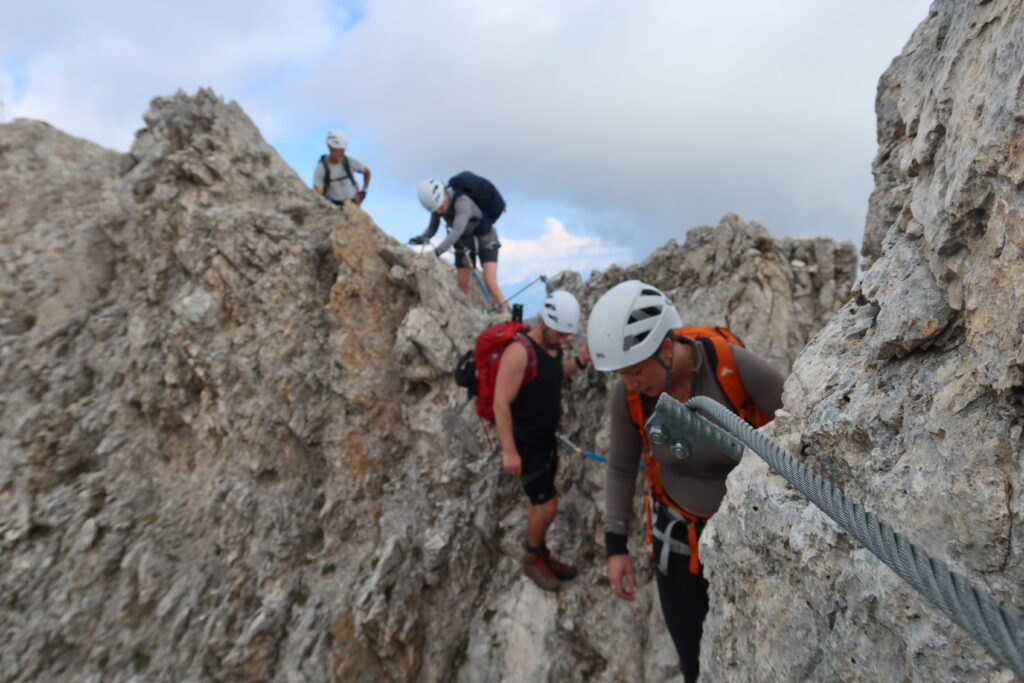
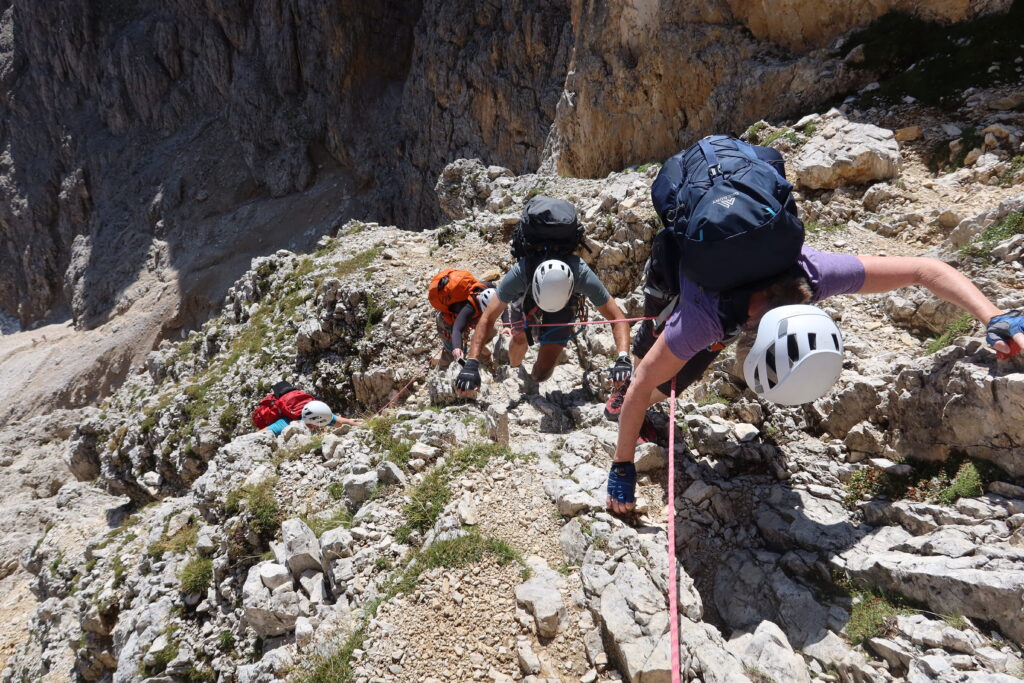
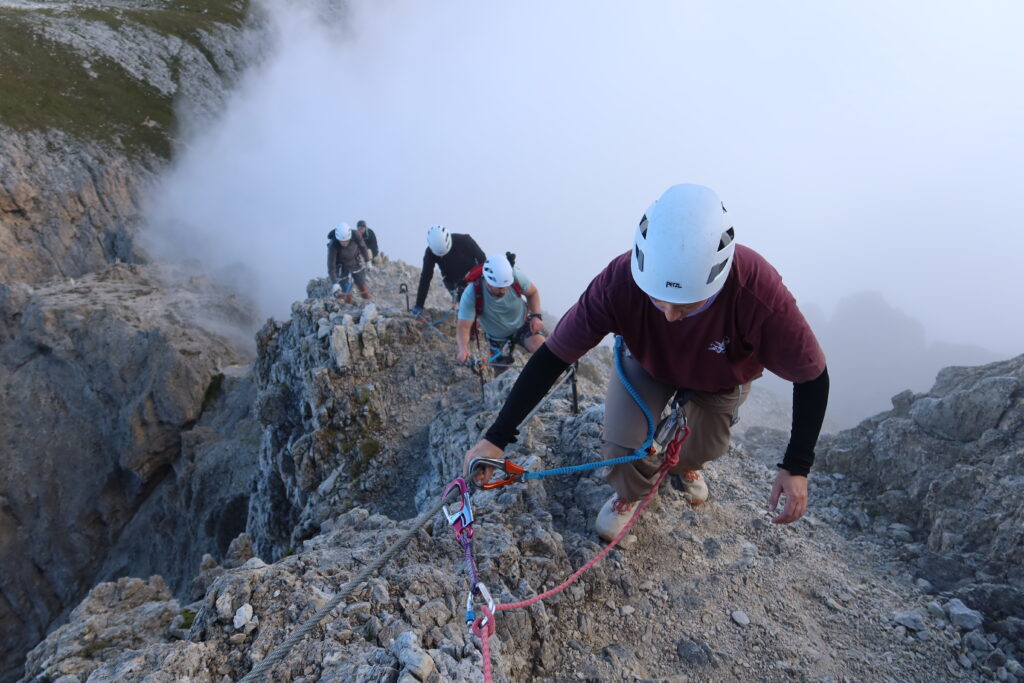
We start out the day with a relatively easy scramble to the Molignon Pass. From there starts the Laurenzi Via Ferrata, probably the most challenging via ferrata of the trip – largely following an airy crest all the way to the Molignon Peak (2850m) and down to the Antermoja Hut (2500 m) for late lunch. We retrace our steps for a few minutes, traverse the Antermoja Pass and arrive at the Grassleitenpass Hut / Rif. Passo Principe (2600 m) for lodging.
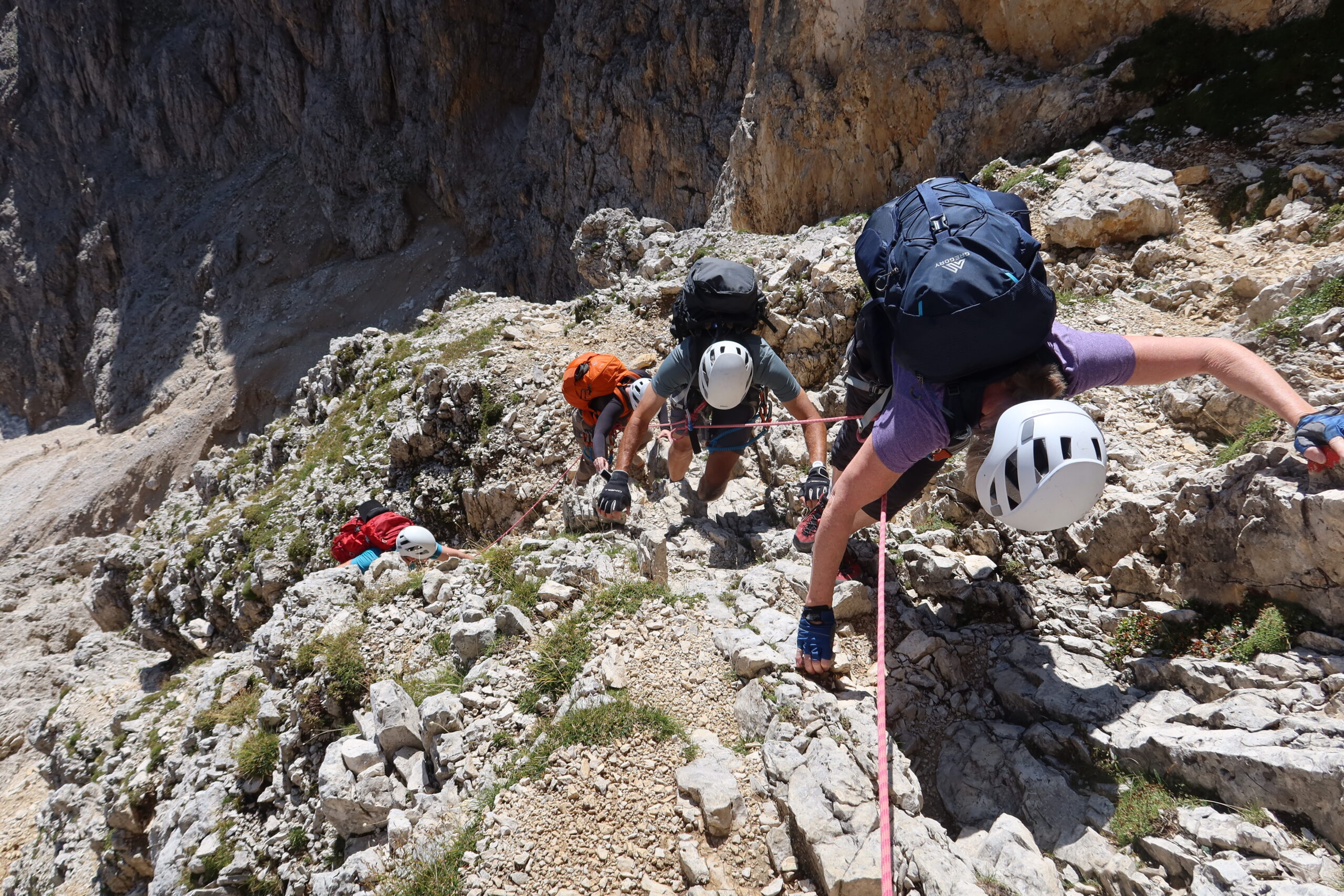
Alternatively, for an easier day, we can also skip the Laurenzi Via Ferrata and take one of two largely non-technical trails to the Rifugio Passo Principe while still maintaining the option of climbing the Kesselkogel / Catanaccio D’Anermoia by via an easier via ferrata traverse route.
800m = 2640ft climb, 640m = 2100ft descent, 7.1km = 4.4mi distance. 6 hrs total walking time with about 3.5 hrs on the Laurenzi Via Ferrata
Day 4: Rifugio Passo Principe / Grasleitenpass Hut – Kesselkogel / Antermoja Via Ferrata – Vajolet Hut – Santnerpass Hut
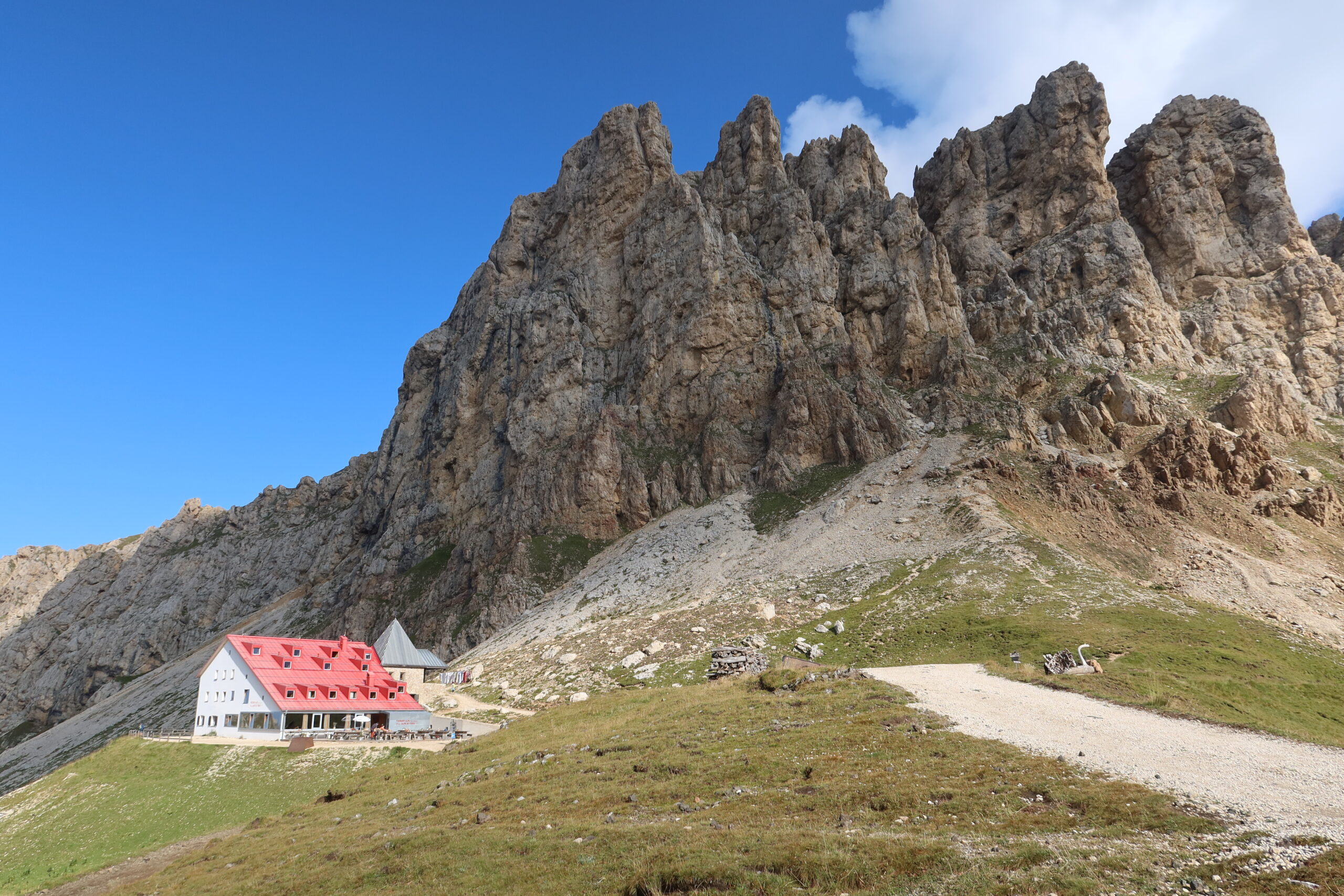
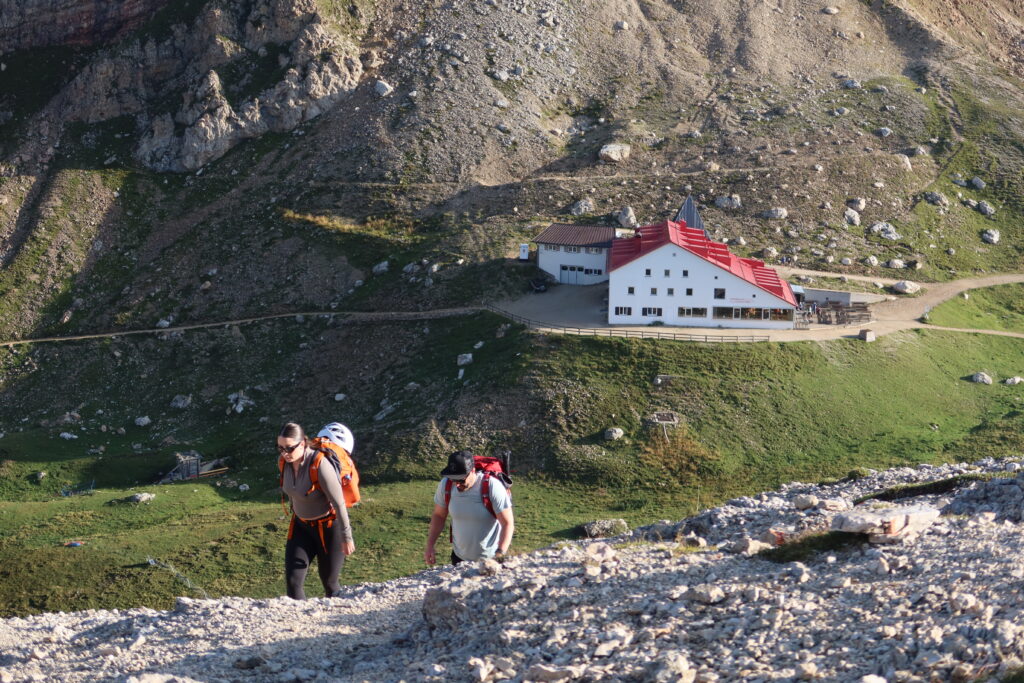
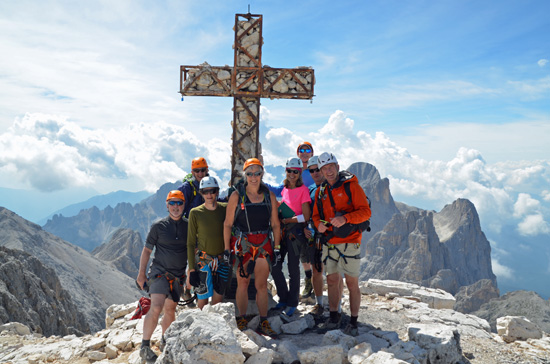
Usually, we start the day with the via ferrata traverse of the Kesselkogel / Catanaccio D’Anermoia (3020 m ) which is optional as we will return to the hut again (about 4 hrs round trip). We descend on an easy trail to the Vajolet Hut (2240m) for late lunch. With a few cables to handrail along, we will climb past the famous Vajolet Towers and the Gartl Hut to the Santnerpass Hut (2740m). The hut has been entirely rebuilt in 2021/22 and offers stunning views of the glaciated peaks of the Ortler and Presanella / Adamello ranges. One of our new favourites in the Dolomites!
1080m = 3560ft climb, 960m = 3170ft descent, 5.7km = 3.6mi distance, 7 hrs with about 4 hrs spent on the Kesselkogel via ferrata.
Day 5: Santnerpass Hut – Santnerpass Via Ferrata – Forcella Coronelle – Roda di Vael Hut
Descent on the moderate Santerpass Klettersteig / Via Ferrata for about 2 hrs, then we re-ascend easier with occasional fixed rope protection to the Coronelle Pass (2570m), then on easier trails via the Zigolade Pass to the Roda di Vael Hut (2280m) for lodging.
560m = 1,850ft climb, 1020m = 3,370ft descent, 8km = 5mi distance. 6 hrs with about 2 hrs spent on the Santnersteig via ferrata.
Alternatively, easier and faster but busier and less scenic is the route via Koelner Hut (2340m) and Hirzelweg to the Rotwand / Roda di Vael Hut (2280m).
Day 6: Masaree Via Ferrata – Rotwand Via Ferrata traverse – Paolina Chairlift
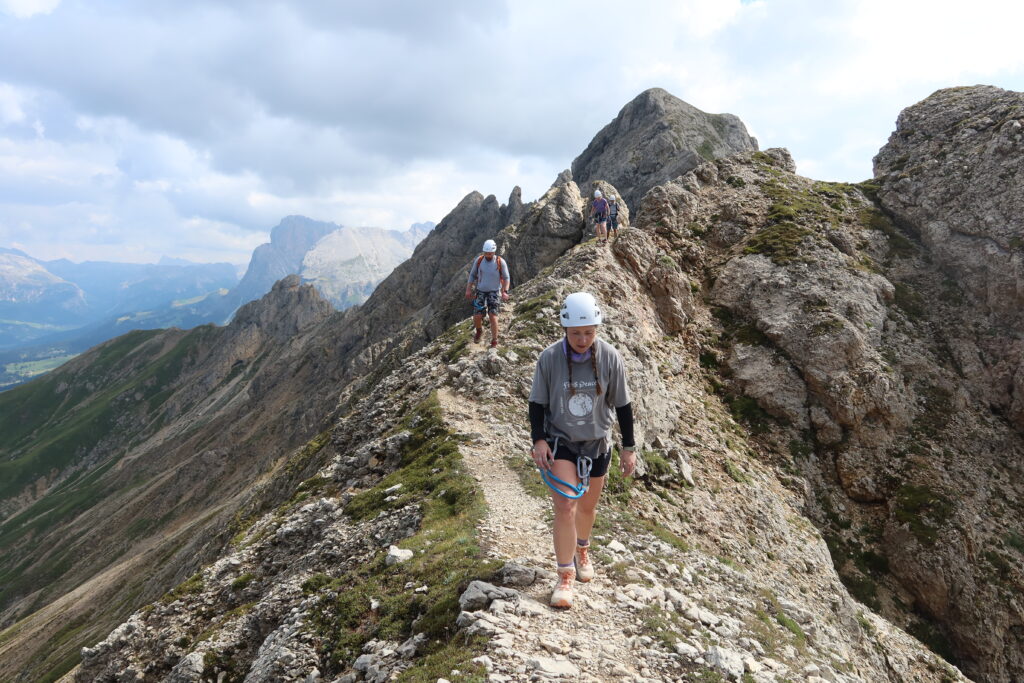
A super-classic via ferrata saved for the last day: A short walk takes us to the Maseree via ferrata – a beautiful ridge traverse with many exciting sections, possibly one of the best via ferratas in the Dolomites. Ideally, we continue with a via ferrata traverse of the Rotwand / Roda Da Vael (2806m) and descend to the Paolina chairlift, which takes us effortlessly down to the Karerpass.
850m = 2,800ft climb, 1000m = 3300ft descent, 5.6km = 3.5 mi distance, 6 hrs with the majority spent on via ferrata.
Alternatively, we skip the Rotwand / Roda di Vael via ferrata and loop back to the hut to pick up our overnight gear. From there we can pick one of two panoramic hiking trails either to Campedie or Paolina, where a gondola takes us back to the main road for taxi pick up to return to our hotel in the Fassa Valley.
Departure/Travel Day:
Trip concludes after breakfast.
Inclusions
Included:
- 6 x days of guiding by an internationally certified (UIAGM / IFMGA), English-speaking mountain guide or guide aspirant under supervision
- Guide expenses
- 2 x nights lodging at a hotel in the Fassa Valley (double / twin room)
- 5 x nights in huts and mountain lodges in small rooms or bunk-bed rooms
- 5 x dinners for the nights in mountain huts
- 7 x breakfasts
- 2 x taxi or bus transfers from our hotel in Fassa Valley to the trailheads and back
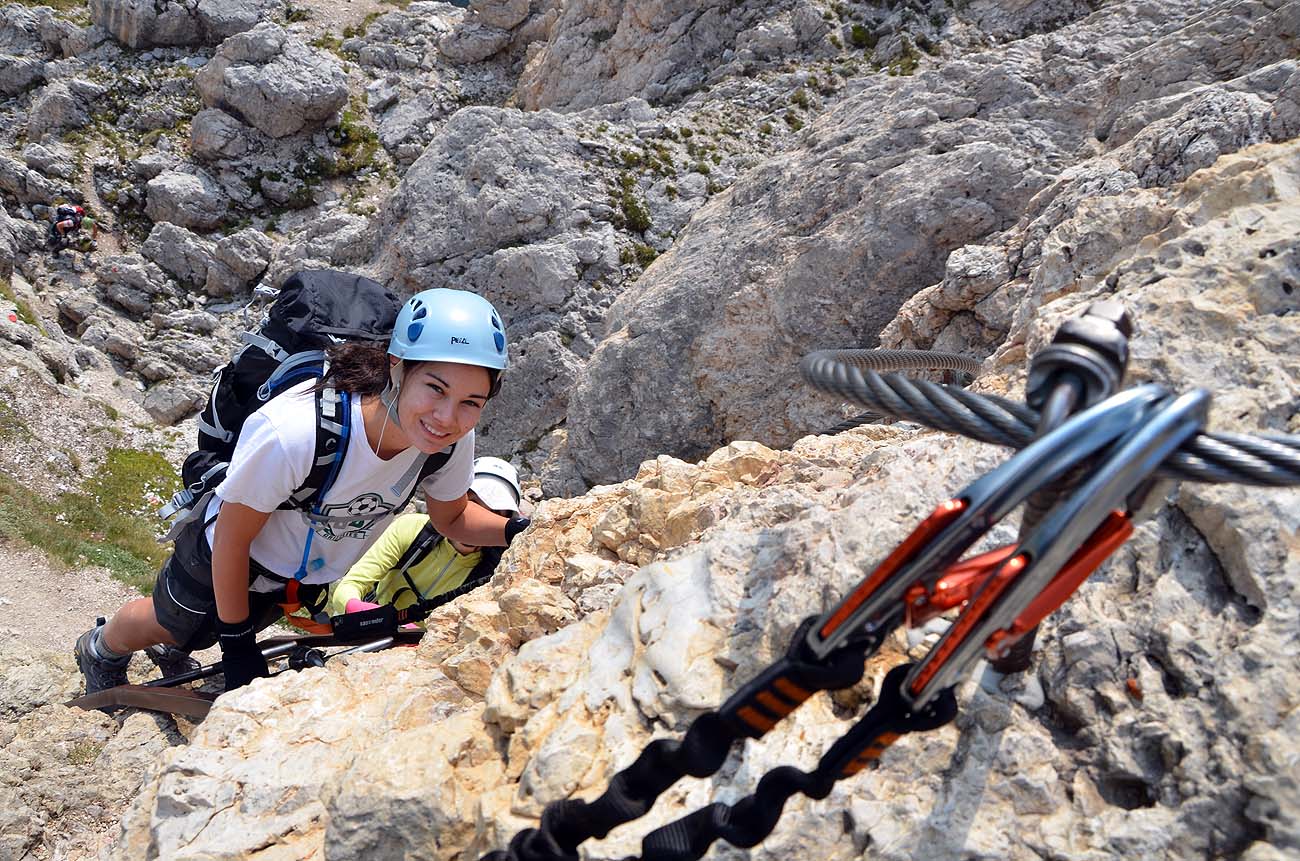
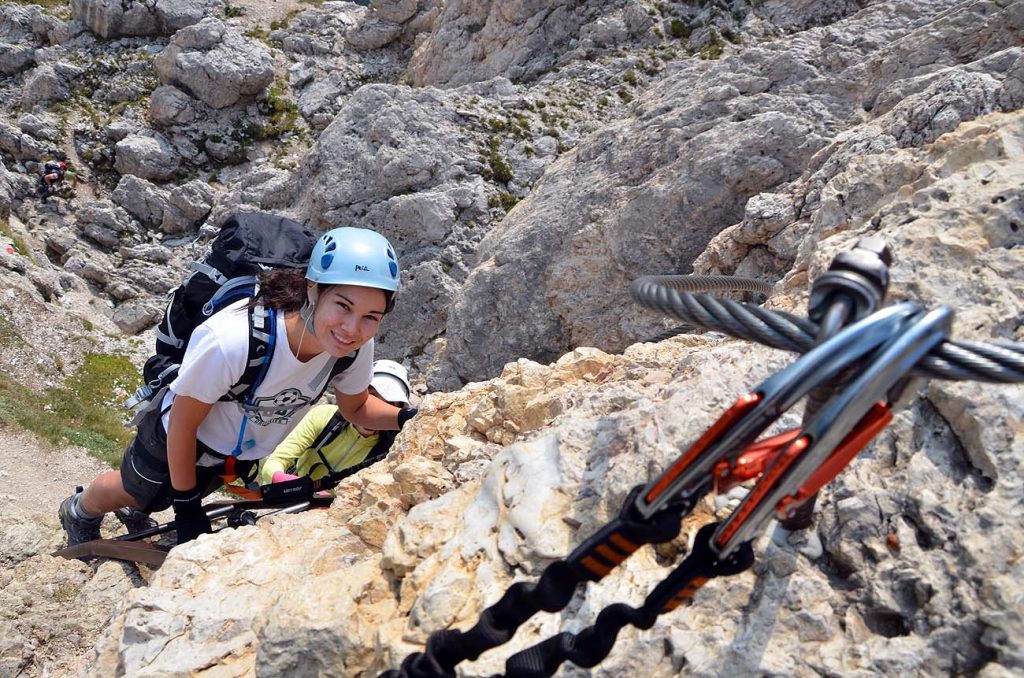
- Equipment use: Harness, helmet, carabiner and shock absorber set for via ferrata
- All trip organization, reservations as well as assistance with all pre- and post-trip preparations
Not Included:
- Single hotel room supplement (€70 – €90 per night x 2)
- Airfare
- Airport shuttles
- 2 x dinners for the nights in hotels
- All beverages (water, alcoholic, and non-alcoholic)
- All lunches and snacks
- Gondolas/chairlifts (if applicable)
- Insurance
- Any additional cost due to changes in the itinerary, may they be caused by weather, mountain conditions or personal preference
Transportation
Our Rosengarten Via Ferrata Hut Trek typically begins in Canazei TN , Val di Fassa. During high season, we may also reserve hotels in Pozza, Vigo di Fassa, or Campitello – all located in the same valley, on the same main road, a few minutes from each other.
For the Western Dolomites (Gardena and Fassa Valley) the closest airports are in sequence (distances provided are to Canazei):
Bozen / Bolzano: 51 km = 50 min (small airport, not many connections)
Innsbruck – Austria: 120 km = 1.45 hrs (small airport, not many connections)
Verona: 190 km = 2.10 hrs
Venice Marco Polo: 200km = 3.20 hrs (via Cortina and Val Badia)
Munich: 320 km = 3.5 hrs (large airport, fast highway and train connections via Innsbruck)
Milan: 360 km = 3.45 hrs (large airport, fast highway and train connections)
By Car:
The Fassa Valley is best reached from the Eisack / Isarco Valley to the west, which hosts the Brenner Pass highway and the main train line connecting Germany and Austria with Italy.
Public Transport:
From the South (Bozen / Bolzano, Verona, Venice, Milan)
1. Train with via Trentitalia to Bozen / Bolzano
2. Bus Transport: line 180 from the train station in Bozen to the town Pera di Fassa. It takes approximately 1.15 hrs and departs 3 x hour from Bozen in summer. From there you can jump on the local bus going up and down the Fassa Valley departing every 15-30mins. It should be about 20 min bus ride from Pera to Canazei depending on traffic.
OR
Venice- Canazei Direct Bus: There is also a direct bus service from Venice to Canazei with Brusetti Bus that departs daily from Venice Piazzale Roma at 7:30am local time and Venice Mestre 15 mins later. The bus takes approximately 5 hours and has stops that include Vigo di Fassa, Pozza, Campitello, and Canazei. The return bus from Canazei to Venice departs daily at 2:30pm local time.
From the North (Munich / Innsbruck / Vienna)
1. Train to Brixen / Bressanone
If you arrive Munich, then train with Deutsche Bahn DB to Brixen / Bressanone
If you arrive Innsbruck, train with SBB services to Brixen / Bressanone
If you arrive Vienna, train with OEBB services to Brixen / Bressanone
2. Bus Transport: An hourly local bus departs from the Brixen/Bressanone train station. Click here for the local bus transport from Brixen/Bressanone to Selva di Val Gardena, from Selva, you will bus to Canazei.
Total travel time by train from Venice – Brixen for example is around 2.5 hrs, to Brixen from Munich about 3.5 hrs.
Transportation around the Fassa Valley – so you’ve arrived at your base town in the Fassa Valley and want to explore the other towns: Pera, Vigo, Pozza, Campitello, Canazei, Alba di Canazei. Take line B101 on the Trentino Trasporti
Local bus lines
Please inquire for pricing should you be interested in a private shuttle transfer.
We also gladly assist you with your public transport logistics
Rosengarten Via Ferrata Private Trip Pricing
Perfect for families, friends, social groups, and more! Book a private trip and reap the benefits, including:
- Discounts for groups of groups of 6 or more
- Custom itineraries available on request
- Private rooms for smaller groups (when available)
For private groups, we can offer the following premiums or discounts on our advertised prices
2 participants: 60% premium in addition to our advertised per person price
3 participants: 40% premium in addition to our advertised per person price
4 participants: 20% premium in addition to our advertised per person price
5 participants: Our advertised per-person price
6 participants: 10% discount from our advertised per person price
For groups larger than 6, please contact us for a custom quote.
Custom trips are available any time from June – September, any duration > 3 days
3 Day, late-season trips in early October are also available, weather-dependent. These are best booked as last-minute trips.
Gear List
Hut-to-Hut Via Ferrata Trek.PDF
Click the link above to download a PDF copy to use as a checklist when preparing for your trip.
Considerations
Packing for a mountain trip is a balancing act. You want your pack to be as light as possible so you can truly enjoy the trek. But you also need to have enough gear to be warm (or cool), comfortable, and well-fed and watered. When buying, renting, or borrowing gear for the trip, please keep weight, performance, and function in mind.
Legend:
Early and Late Season Trips: June and September can be considered early and late season trips – depending on residual snowpack (June) or early snow/colder temps (September)
*Optional
**Optional but recommended
Technical Gear
Provided by OnTop Mountaineering:
The following equipment will be provided to you by OnTop Mountaineering for the duration of your trek. This rental is included as part of your trip package. Should you not require the use of this gear, please inform your Trip Coordinator.
- Via ferrata clip-in set
- Climbing harness
- Climbing helmet
Bring or Rent the Following:
- Sturdy, waterproof, leather trekking boots or light mountaineering boots, ideally with high ankle support.
- Daypack (30-40 liters) with rain cover specific to the pack
- Good quality, thin, well-fitting leather gloves, preferably fingerless. Bike and belay gloves work well.
- Lightweight, collapsible hiking poles*
- Microspikes or yaktrax-type traction devices that fit your boots (for early and late season trips)
- Short summer gaiters (for early and late season trips)*
Lodging
- Sleeping bag liner for the huts – silk is lightest (MANDATORY for HUT LODGING)
- Toiletries and small towel (quick-drying/ microfiber)
- Cash – euros for lunches, drinks, snacks, showers, etc.
- Light hut slippers or crocs
- Ear plugs**
- Alpine Club card*
Clothing
We recommend using the ‘layering system’: Bring light, technical clothing that doesn’t take much space in your backpack and dries quickly when sweaty or wet. Layers must be put on and taken off quickly as weather conditions change during the day. There may be days when you can wear cotton, but your main clothing choices should be synthetic or wool. Merino wool is a nice material for base layers and t-shirts because it is comfortable, warm, and it does not retain odours, even after many days of use.
- Wind and waterproof shell jacket with hood (Gore-Tex or similar)
- Lightweight wind and water-resistant over pants (Gore-Tex or similar)
- Lightweight synthetic trekking pants or zip-offs
- Medium weight Primaloft jacket with hood
- Medium weight fleece sweater
- Synthetic or wool base layers – top and bottom
- Synthetic shorts and t-shirt
- Quick-drying sports bra
- 2-3 pairs of good quality trekking socks
- Warm hat that covers your ears
- Lightweight synthetic or wool gloves
- Sun hat, preferably with a wide rim
- Spare socks and underwear
- Bandana or Buff*
Other items
- Sunglasses with high UV protection
- Sunscreen and lip protection with high SPF
- Small container bug spray or cream
- One or two, one-litre water bottles
- Headlamp with new battery
- Personal first aid kit and other needs (eg. blister kit, prescription medicine, anti-inflammatory, contact lenses, prescription glasses, feminine hygiene, toilet paper, hand sanitizer etc.)
- Passport, health and travel insurance documents
- Light stuff sacs or Ziploc bags to keep your backpack organized and important items dry**
- Hiking snacks – candy bars, dried fruit, nuts, etc.**
- Cellphone with charging cable*
- Adaptor for European charging system*
- Portable powerbank*
- Pocket knife*
- Camera, spare batteries*
- Maps, GPS, altimeter watch*
FAQ
Do I need to sign a Release of Liability & Assumption of Risk Agreement (a.ka. liability waiver)?
Yes, you do. Mountaineering, skiing, climbing, hiking, via ferrata and all other wilderness and adventure travel activities are inherently risky with potential for injuries or even death.
It is very important to us that you are aware of those risks before you start the booking process, which includes filling out a booking form and paying a deposit.
With signing the liability waiver, you confirm that you understand the potential risks and hazards, and are willing to accept the risks, which includes giving up legal rights you may have.
This would also be the time to ask questions or address concerns before you book.
For your reference here is a link to our Liability Waiver. Our booking terms & cancellation policy with more details can be found here
Trip Related Questions:
Meeting Point
Meet on the first hiking day at 8.00AM at your hotel (lodging and breakfast included in trip price) for a trip briefing, distribution of rental gear followed by a taxi ride to the first trailhead.
Climate, Weather, Temperatures
The Dolomites, being on the “sunny side of the Alps” are usually blessed with favourable weather. However, as anywhere in the mountains, there is also a chance to see some snow, if a storm hits. This is rare in July and August but can happen in June and September. Day time temperatures can range from -5C (23F) to 25C (77F).
Lodging at the huts
- The huts are heated and provide sheets and comforters or wool blankets – however, in some of the huts the sheets/blankets are not changed between each client stay, so it is mandatory to bring a sleeping bag liner. The lightest models available are made of silk and weigh around 100 grams (1/2 pound).
- The Huts included along our route vary in size from very large to small and rustic depending on their location – all are built in magnificent settings. Some of the huts only offer coed, multi-bed bunk rooms for 10 to 14 trekkers (when fully occupied).
- When lodging in dorm rooms/ non-private rooms, you will be sleeping with your fellow trekkers and most likely other trekkers as well. If you are a sensitive sleeper, we highly recommend ear plugs, an eye mask, and perhaps a sleep aid.
Breakfasts and Dinners at the Huts
- Breakfasts typically consist of tea/coffee, bread, jams, cold cuts or ham, cheese, muesli, cereal with milk or yogurt. More remote huts may have smaller breakfast offerings. If you have your preferred cereal for breakfast, granola bar or power snack, you should probably bring it along from home, as it might not be available in the small food stores in Italian mountain villages or at the huts.
- Dinners are usually between 3- 4 courses (“mezza pensione”) which consist mostly of pasta or soup, a meat entree and dessert and/or cheese.
Lunches
Lunches are not included in our trip packages. We recommend packing a lunch for the first day of trekking. Packed lunches are available at each hut and must be ordered the night before. If you have a guide, please discuss as a group what the next day’s lunch plans are as some group may opt to dine-in at a hut along the way.
Luggage Storage and Transfers
You can use the hotel luggage storage facilities at your own risk. Neither OnTop nor the hotel accepts any responsibility for loss of or damage to the luggage or the contents (including any valuables, even if we have been advised) during storage, the disposal process or any luggage transfers that may be part of your trip package. That being said, we have never had any issues with lost luggage during storage or transfer.
What are the huts like? Double rooms? Showers? Food choices?
The huts along the Rosengarten route vary. While the majority of the huts offer showers, only some offer private rooms. The others offer bunkbed-style sleeping with up to 10 people per room (if more beds than 10 this will be mentioned to you for approval). Upon request and with an early booking, we can organize your trek with as many private (double, triple, quad) room options as possible.
The food is always delicious and plentiful (as is the Italian wine, beer, and aperol spritz). 3-4 course dinners featuring local cuisine like Knödel (dumplings), spaeztle, goulash, stuffed ravioli, pasta, are common. Some huts are situated on or near farmed-land where you can expect farm-fresh butter, cheese, and meats.
Special diets like vegetarian, pescatarian, and gluten-free be accommodated. Gluten-free diets are treated as an allergy but cross-contamination in the small kitchens and dining rooms is possible. If you have severe or life threatening allergies please make us aware before booking. Other special diets, like a vegan diets or religious diets, can usually be accommodated but the choices are extremely limited and we ask you to bring food supplements to prevent calory deficits with you. Please also make us aware before booking.
Lunches, drinks, and snacks are not included in the trip price. All huts will offer these for sale. We recommend packing a lunch for the first day of trekking. To-go lunches are available for purchase and ready for you to pick up at check out the follow morning. Most huts also offered a restaurant-style seated lunches where you can order alcoholic and non-alcoholic beverages, meals, and snacks. Hours will vary with each hut.
Is drinking water available at huts or creeks in the Dolomites?
Generally all guarded huts in the Dolomites have running water. At some huts, it is labelled as “not potable” which is not because the water is contaminated but rather because it is not guaranteed that it is potable. For example the water could be collected from surface water from a small glacier and the location of water collection changes over the summer and has to be adjusted at times. Most people drink the water at the huts with no problems. If you are uncomfortable with this, take tablets, water filters, water sterilizers, or purchase bottled water directly at the huts. A liter of mineral water costs around 3-6 euros.
Creek water in the Dolomites is usually potable and so far nobody that we know of ever had any problems. That being said, it is nice to drink from creeks that have a good flow and are originating in high regions that have no source of contamination (i.e. no grazing cows etc). We don’t recommend to drink from lakes in the Dolomites.
Luggage Storage and Transfers
You can use the hotel luggage storage facilities at your own risk. Neither OnTop nor the hotel accepts any responsibility for loss of or damage to the luggage or the contents (including any valuables, even if we have been advised) during storage, the disposal process or any luggage transfers that may be part of your trip package. That being said, we have never had any issues with lost luggage during storage or transfer.
Sporting Stores – Buy or Rent
There are a few sport stores within close walking distance or via bus from the hotels in Fassa Valley. Your hotel front desk will direct you to the nearest stores. Keep in mind, that unless it’s an emergency (lost luggage), you should purchase your hiking boots in advance to break them in – no one wants a blister to form at the start of their trek!
In the Fassa Valley there are quite a few sporting store options that you can view here. Renting equipment for soft goods like backpacks and boots is not common and might not be possible.
Medical/Rescue and Trip Cancellation Insurance
Medical evacuation insurance is mandatory for participation in all OnTop Mountaineering (OnTop ltd) Trips.
Common policies sold by travel agents or policies included in your credit card contract tend to exclude adventure travel, including trekking above 2000m, mountaineering, roped travel, ski & snowboard, ski mountaineering etc. if you read through the fine print. For adventure travel policy recommendations see our website: OnTop travel insurance recommendations. You may get the best coverage if you book travel insurance policies within 14 days of paying your trip deposit. You may also want to consider additional insurance coverage like CFAR or trip cancellation.
Common policies sold by travel agents or policies included in your credit card contract tend to exclude adventure travel, including trekking above 2000m, mountaineering, roped travel, ski & snowboard, ski mountaineering etc. if you read through the fine print. For adventure travel policy recommendations see our website: OnTop travel insurance recommendations. You may get the best coverage if you book travel insurance policies within 14 days of paying your trip deposit. You may also want to consider additional insurance coverage like CFAR or trip cancellation.
We recommend pandemic coverage with your insurance policy.
Can I Do It?
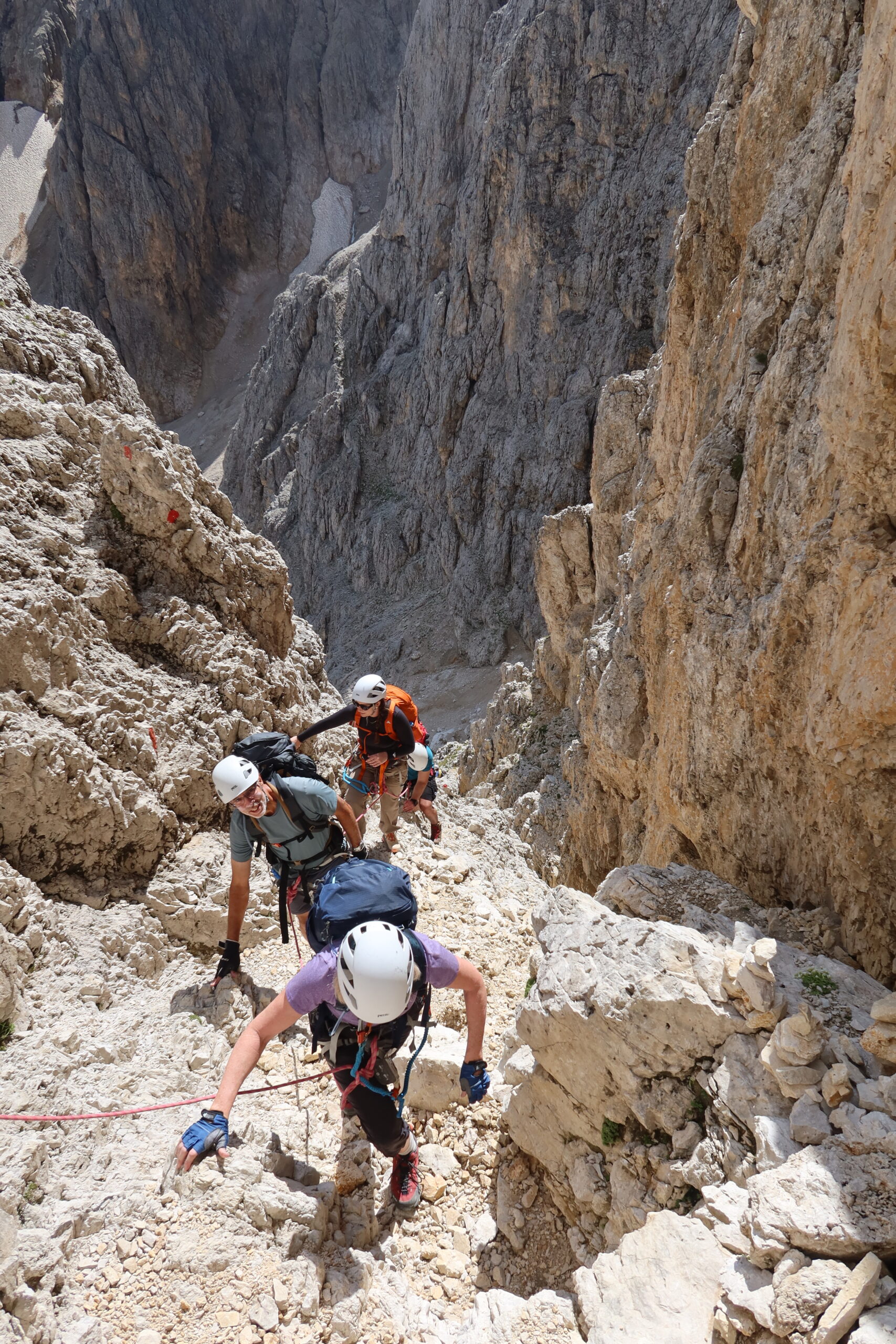
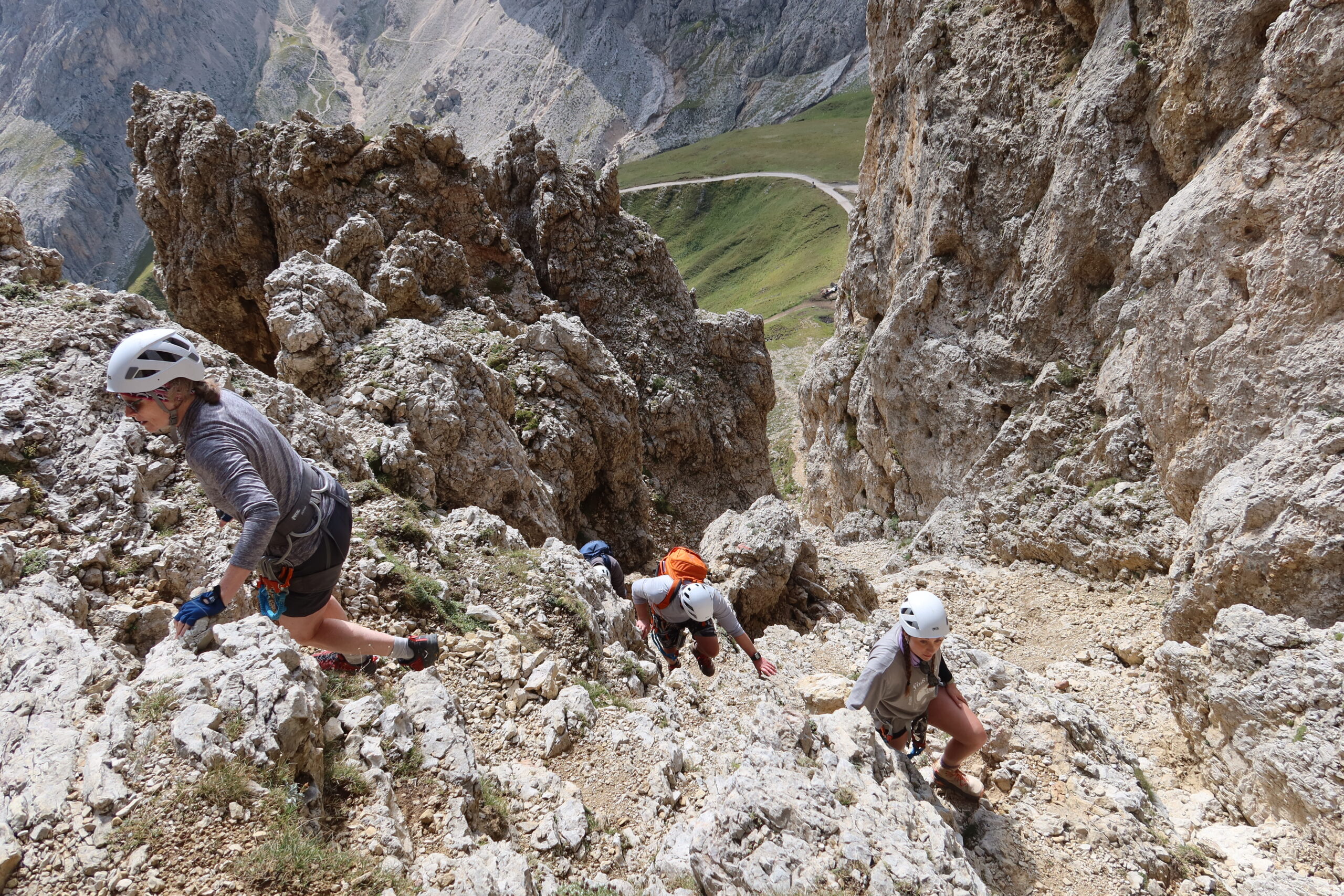
Our Rosengarten Via Ferrata Trek is meant as an advanced via ferrata trip that is best suitable for participants who already have experience with via ferrata, scrambling and/or rock climbing. The trip may also work for fit and athletic via ferrata beginners who are not easily intimated by exposed trails and drop-offs. Most days will see you on your feet for 6 – 8 hrs at a moderate pace and involve frequent scrambling on via ferratas, which is less strenuous in a cardio-vascular sense but requires good general fitness and head strength to be comfortable on exposed trails that may or may not feature via ferrata fixtures.
One strength of the itinerary is the high level of flexibility to adjust the program to adverse weather or the group’s preferences. Most days offer multiple alternatives to arrive at the destination and/or we reach our destination by early afternoon and guests have the option between another via ferrata, a peak ascent or relaxing with a good book and a cappuccino on the hut terrace. On a custom trip basis, our guests have a daily choice between via ferrata itinerary and non-technical hiking trail while still arriving at the same destination every day. It also gives couples the option to split up for part of the day and reunite in the afternoon upon arrival at our daily destination.
2026 SCHEDULED DEPARTURES
7 nights, 6 days trekking
Sunday – Sunday
June 14 – 21
June 21 – 28
June 28 – July 5
July 4 – 11 (Saturday Departure)
July 12 – 19
July 19 – 26
July 26 – Aug 2
Aug 2 – 9
Aug 9 – 16
Aug 16 – 23
Aug 23 – 30
Aug 30 – Sept 6
Sept 6 – 13
Sept 13 – 20
Sept 20 – 27
Sept 27 – Oct 4
First and last day are travel days
CUSTOM TRIP DEPARTURES
Custom trips at any time from early June to end of September!
For details click “Custom Trips” Tab
GROUP TRIP SIZE
3-6 Clients: 1 Guide
TRIP INCLUSIONS
- 6 x days of guiding by an internationally certified (UIAGM / IFMGA), English-speaking mountain guide or guide aspirant under supervision
- Guide expenses
- 2 x nights lodging at a hotel in the Fassa Valley (double / twin room)
- 5 x nights in huts and mountain lodges in small rooms or bunk-bed rooms
- 5 x dinners for the nights in mountain huts
- 7 x breakfasts
- 2 x taxi or bus transfers from our hotel in Fassa Valley to the trailheads and back
- Equipment use: Harness, helmet, carabiner and shock absorber set for via ferrata
- All trip organization, reservations as well as assistance with all pre- and post-trip preparations
For a full list of services included, not included, and add-ons, please select our “Trip Inclusions” Tab.